Dear dedicated reader,
It seems strange to qualify anything that I write to you, dear reader, as ‘personal’ since my account of my experiences here can only be described as personal. But I have a personal update that doesn’t have to do with anecdotes of delightfully incorrect sentence structure or classroom management or even cheating on exams.
I’ll be staying here in India for another year and even better than that: I’ll be staying here in Kadod! Our Foundation is expanding our program model to two additional schools in the surrounding area next year and over the past few months has been discussing the possibility of hiring an India Director to manage its operations in country. I’m happy to share that as of this morning, that person will be me! While the decision to trade in my chalk and duster for a mobile and mobility is my own, it does seem strange to choose a student-less existence after three years of working with students full-time.
Oddly enough, in an unpredictable twist to my own story, it seems I cannot get enough of Gujarat. That, however, will not stop me from returning to the U.S. from April 8th to June 2nd. I will be in Philadelphia, New York and Boston during that time, so if that is in your general direction, let’s connect.
Best,
Cat
Friday, February 27, 2009


Sunday, February 15, 2009
You Coming Sister Marriage?
Dear dedicated reader,

I came into my Spoken English class a week ago to find my boys huddled in a group around one bench, whispering feverishly to one another in Gujarati. I heard a snatch of “Melisha ma’am” and “Ketrin ma’am” as they spoke. What were they up to?
The huddle broke as they saw me and I saw Hitesh, my small, rambunctious and usually unprepared student from 9D hide something quickly behind his back. Oh god, I thought, I hope this tete a tete isn’t yet another attempt to scare me with a very realistic looking plastic lizard.
He walked slowly forward and a wide, toothy grin broke out in a shine across his face.
“Miss,” he said in his voice which is surprisingly scratchy for a kid, bringing his hand out from behind his back and presenting its contents to me, “you come in my sister’s marriage?”
I looked down at what he was holding out to me. It was a card upon which “Melissa ma’am and Cathrine ma’am” had been scrawled on the neat blank line designated for names and inside it was full of the Gujarati of a formal wedding invitation: our first.
“Of course,” I replied, delighted.
Apparently, Melissa and I had graduated from crashing weddings with Sejalben to being invited in our own right. Of course, this presented a new problem: were we ready to strike out on our own? I mean, an Indian wedding is not exactly the minute to minute affair of a New York wedding: there is lots of idle time between dinner and the ceremony, sometimes hours, for guests to roam and chat and somehow everyone (except for the clueless American teachers) knows how long this time is supposed to be. How would we fare without our crutches?
It turns out I needn’t have worried.
“We’re going to be late,” I whined as we readied ourselves to leave the house this afternoon for the wedding. As we threw the bolt closed on our front door, I ran my eye over Melissa’s sari and my own bangled arms, hoping we would be up to the measure of the critical Indian aunty’s eye.
We made our way as quickly as we could up the main road of Kadod and back into the neighborhood where Hitesh and his family live. I had often seen him when I was out on my bike, running around his plaid play shirt and school uniform pants. As we reached the road where I knew he lived, I realized I didn’t know where we were supposed to go. As many times as I had threatened to go to his house and tell his father about his Gujarati jokes, his missing text book, his constant lack of a pen, I had never actually done it because of his disarmingly adorable smile and so I didn’t actually know where he lived.
Confused, we stopped just outside the large temple which dominates this part of town and contemplated our next move. Kids and adults in finery were milling around, but there was no sign of any of our students. Melissa and I looked at each other. We were failing our first closed-book cultural test.
Luckily, our cheat sheet arrived.
“Miss!” Hitesh bounded out of a house up the street where a large tent had been set up for the wedding proceedings. He was dressed in a flat pressed blue collar shirt with a sewn in slogan on the back proclaiming ‘No Fear!” and a pair of tight jean pants. His hair had been slicked back and despite his diminutive size he was almost looking fourteen years old (which he is).
He stopped bounding just in front of me. “Hungry? You eat?” He asked me, smiling excitedly with eyes darting back and forth between me and Melissa. He immediately started leading us towards a large gravel yard at the end of the street where long bolts of cloth had been laid in parallel with large platters and bowls made from dried leaves placed in front. He indicated that we should sit, so after a moment of weak hesitation we did, and he plopped down right next to me.
As soon as we sat, the other mass of children who’d started to follow us out of curiosity and it turns out would follow us all night, also sat. By now, eating dinner had gained momentum and adults were following our lead and sitting to receive the portions that were being doled out by local boys (all my students, incidentally) onto the leaf plates.
“Miss,” Hitesh said, catching my attention and pointing, “this is my aunt, and that one, my uncle and that one my grandfather and there my grandmother.” It was the longest English sentence I had ever heard him speak.
“All your relatives are here?” I asked him.
“Yes, miss, and my sister, her marriage, she is in house for beauty parlor!” He said laughing at his own wit. As Mayur, one of his classmates, threw down a large spoonful of unidentified cooked and spiced vegetables onto my platter with a plop, Hitesh pointed at it.“In Gujarati, saag,” he said seriously and I nodded with a smile in appreciation for his identification, watching out of the corner of my eye as the boys who moved down the closely packed line of plates serving food kicked up dust as their shoes shuffled down the row. I then watched it settle on my food, smiled at Hitesh, and dug my fingers into the saag to take a bite.
After dinner, Hitesh took us and the cadre of seven to ten year olds who’d decided that they’re new occupation was trailing American teachers like lemmings to his uncles’ house where his sister was being readied for the wedding. He tried to shoo away the kids but they persisted in staying and staring at us with their big eyes so he merely blocked the stairwell as we made our way up the rickety steps to the second floor where his twenty year old sister Pritee was being adorned with jewels by her best friends. She tried to get up as we entered. “No no!” we insisted as we indicated she should sit. Both her arms were covered from the sleeve of her sari blouse all the way to her finger tips with deep, dark intricate mehndi.
Hitesh, who after a few minutes came running into the room after successfully stopping the onslaught of pre-teens introduced us to his sister as “my American teachers.” After a short congratulations, we left the house. As we got outside he said, “Now I am fresh, miss.”
I stopped, confused I stumbled to put our discarded sandals back on just outside the doorway of his house. “What do you mean?” I asked him.
He threw up his arm and exposed his freshly scented armpit to me. “Full Perfume!” He shouted happily.
“Oh, ah yes,” I said, as the scent of white jasmine floated towards me, “very nice.”
Undeterred by my tepid response, Hitesh charged forward into the street, motioning for us to follow. “She sister marriage nine and coming my house now groom and you see!” He smiled over his shoulder as he marched onwards.
Confused but trusting that he had everything in hand, we followed him (and the seven year olds followed us) out across the street to a house a little further down next to the gravel yard in which we had enjoyed our carefully narrated wedding banquet.
Leaving our sandals at the threshold, we ducked our heads past the low dark doorway and found ourselves in a room full of glittering saris and embroidered kurtas with relatives of the groom inside them. The groom himself lay sprawled out on the floor on a mat in the corner, relaxing but looking nervous. We gave a quick palms together ‘Namaste’ to everyone as moved through the room to the back, following the excitable Hitesh.
Inside the room, an old wrinkled woman in a purple silk sari indicated that we should sit, saying “Please seat yourself,” over and over to us in Gujarati. She came and sat next to us and took Melissa’s arm in her firm grip. One of the clan of seven year olds was sent dutifully for cold drinks.
She began to speak in a rhythmic, slow Gujarati, her tongue caressing each sound carefully. Her care, unfortunately, was lost on us as we looked at her blankly and then at Hitesh, who glancing quickly at the ceiling with a concentrated look, began to try and translate.
“You, married? She ask?” He said. We told her no.
“You… liking India?” His scratchy voice intoned again with intense concentration. This question and answer continued and each time he dutifully translated so the groom’s mother would be able to comprehend our answers.
I was ecstatic, but not because of the conversation or because of India. With every sentence of English Hitesh uttered, I became even more so. Here was a student who never, and I mean never, spoke English in the classroom if it could be avoided. Despite coming to Spoken English class everyday, he’d loll around at his bench, tell me in Gujarati that he didn’t bring a pen, and then after I gave him one wouldn’t open his notebook or follow directions and after it all would look at me sadly and say plaintively, “Miss, outside game?”
This was different, however: perhaps born out of a desire to meet the demanding rules of Indian hospitality and also his happiness at our coming to the event, Hitesh was now presented with a genuine communicative goal. And hence flowed forth the English!
I guess it was all he needed.
Best,
Cat

I came into my Spoken English class a week ago to find my boys huddled in a group around one bench, whispering feverishly to one another in Gujarati. I heard a snatch of “Melisha ma’am” and “Ketrin ma’am” as they spoke. What were they up to?
The huddle broke as they saw me and I saw Hitesh, my small, rambunctious and usually unprepared student from 9D hide something quickly behind his back. Oh god, I thought, I hope this tete a tete isn’t yet another attempt to scare me with a very realistic looking plastic lizard.
He walked slowly forward and a wide, toothy grin broke out in a shine across his face.
“Miss,” he said in his voice which is surprisingly scratchy for a kid, bringing his hand out from behind his back and presenting its contents to me, “you come in my sister’s marriage?”
I looked down at what he was holding out to me. It was a card upon which “Melissa ma’am and Cathrine ma’am” had been scrawled on the neat blank line designated for names and inside it was full of the Gujarati of a formal wedding invitation: our first.
“Of course,” I replied, delighted.
Apparently, Melissa and I had graduated from crashing weddings with Sejalben to being invited in our own right. Of course, this presented a new problem: were we ready to strike out on our own? I mean, an Indian wedding is not exactly the minute to minute affair of a New York wedding: there is lots of idle time between dinner and the ceremony, sometimes hours, for guests to roam and chat and somehow everyone (except for the clueless American teachers) knows how long this time is supposed to be. How would we fare without our crutches?
It turns out I needn’t have worried.
“We’re going to be late,” I whined as we readied ourselves to leave the house this afternoon for the wedding. As we threw the bolt closed on our front door, I ran my eye over Melissa’s sari and my own bangled arms, hoping we would be up to the measure of the critical Indian aunty’s eye.
We made our way as quickly as we could up the main road of Kadod and back into the neighborhood where Hitesh and his family live. I had often seen him when I was out on my bike, running around his plaid play shirt and school uniform pants. As we reached the road where I knew he lived, I realized I didn’t know where we were supposed to go. As many times as I had threatened to go to his house and tell his father about his Gujarati jokes, his missing text book, his constant lack of a pen, I had never actually done it because of his disarmingly adorable smile and so I didn’t actually know where he lived.
Confused, we stopped just outside the large temple which dominates this part of town and contemplated our next move. Kids and adults in finery were milling around, but there was no sign of any of our students. Melissa and I looked at each other. We were failing our first closed-book cultural test.
Luckily, our cheat sheet arrived.
“Miss!” Hitesh bounded out of a house up the street where a large tent had been set up for the wedding proceedings. He was dressed in a flat pressed blue collar shirt with a sewn in slogan on the back proclaiming ‘No Fear!” and a pair of tight jean pants. His hair had been slicked back and despite his diminutive size he was almost looking fourteen years old (which he is).
He stopped bounding just in front of me. “Hungry? You eat?” He asked me, smiling excitedly with eyes darting back and forth between me and Melissa. He immediately started leading us towards a large gravel yard at the end of the street where long bolts of cloth had been laid in parallel with large platters and bowls made from dried leaves placed in front. He indicated that we should sit, so after a moment of weak hesitation we did, and he plopped down right next to me.
As soon as we sat, the other mass of children who’d started to follow us out of curiosity and it turns out would follow us all night, also sat. By now, eating dinner had gained momentum and adults were following our lead and sitting to receive the portions that were being doled out by local boys (all my students, incidentally) onto the leaf plates.
“Miss,” Hitesh said, catching my attention and pointing, “this is my aunt, and that one, my uncle and that one my grandfather and there my grandmother.” It was the longest English sentence I had ever heard him speak.
“All your relatives are here?” I asked him.
“Yes, miss, and my sister, her marriage, she is in house for beauty parlor!” He said laughing at his own wit. As Mayur, one of his classmates, threw down a large spoonful of unidentified cooked and spiced vegetables onto my platter with a plop, Hitesh pointed at it.“In Gujarati, saag,” he said seriously and I nodded with a smile in appreciation for his identification, watching out of the corner of my eye as the boys who moved down the closely packed line of plates serving food kicked up dust as their shoes shuffled down the row. I then watched it settle on my food, smiled at Hitesh, and dug my fingers into the saag to take a bite.
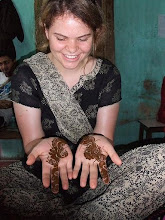
After dinner, Hitesh took us and the cadre of seven to ten year olds who’d decided that they’re new occupation was trailing American teachers like lemmings to his uncles’ house where his sister was being readied for the wedding. He tried to shoo away the kids but they persisted in staying and staring at us with their big eyes so he merely blocked the stairwell as we made our way up the rickety steps to the second floor where his twenty year old sister Pritee was being adorned with jewels by her best friends. She tried to get up as we entered. “No no!” we insisted as we indicated she should sit. Both her arms were covered from the sleeve of her sari blouse all the way to her finger tips with deep, dark intricate mehndi.
Hitesh, who after a few minutes came running into the room after successfully stopping the onslaught of pre-teens introduced us to his sister as “my American teachers.” After a short congratulations, we left the house. As we got outside he said, “Now I am fresh, miss.”
I stopped, confused I stumbled to put our discarded sandals back on just outside the doorway of his house. “What do you mean?” I asked him.
He threw up his arm and exposed his freshly scented armpit to me. “Full Perfume!” He shouted happily.
“Oh, ah yes,” I said, as the scent of white jasmine floated towards me, “very nice.”
Undeterred by my tepid response, Hitesh charged forward into the street, motioning for us to follow. “She sister marriage nine and coming my house now groom and you see!” He smiled over his shoulder as he marched onwards.
Confused but trusting that he had everything in hand, we followed him (and the seven year olds followed us) out across the street to a house a little further down next to the gravel yard in which we had enjoyed our carefully narrated wedding banquet.
Leaving our sandals at the threshold, we ducked our heads past the low dark doorway and found ourselves in a room full of glittering saris and embroidered kurtas with relatives of the groom inside them. The groom himself lay sprawled out on the floor on a mat in the corner, relaxing but looking nervous. We gave a quick palms together ‘Namaste’ to everyone as moved through the room to the back, following the excitable Hitesh.
Inside the room, an old wrinkled woman in a purple silk sari indicated that we should sit, saying “Please seat yourself,” over and over to us in Gujarati. She came and sat next to us and took Melissa’s arm in her firm grip. One of the clan of seven year olds was sent dutifully for cold drinks.
She began to speak in a rhythmic, slow Gujarati, her tongue caressing each sound carefully. Her care, unfortunately, was lost on us as we looked at her blankly and then at Hitesh, who glancing quickly at the ceiling with a concentrated look, began to try and translate.
“You, married? She ask?” He said. We told her no.
“You… liking India?” His scratchy voice intoned again with intense concentration. This question and answer continued and each time he dutifully translated so the groom’s mother would be able to comprehend our answers.
I was ecstatic, but not because of the conversation or because of India. With every sentence of English Hitesh uttered, I became even more so. Here was a student who never, and I mean never, spoke English in the classroom if it could be avoided. Despite coming to Spoken English class everyday, he’d loll around at his bench, tell me in Gujarati that he didn’t bring a pen, and then after I gave him one wouldn’t open his notebook or follow directions and after it all would look at me sadly and say plaintively, “Miss, outside game?”
This was different, however: perhaps born out of a desire to meet the demanding rules of Indian hospitality and also his happiness at our coming to the event, Hitesh was now presented with a genuine communicative goal. And hence flowed forth the English!
I guess it was all he needed.
Best,
Cat
Friday, January 30, 2009
An Overdue Haircut
Dear dedicated reader,
When I first met Mr. Tailor’s androgynous offspring, Krishna, I was stymied.
“Your… child is so cute,” I said, calling out the reserve word I formerly used when making cold calls to parents in the Boston Public School system when I couldn’t determine the sex of their child.
“Oh Thank You!” Kamleshbhai (Mr. Tailor’s true name, or so we’ve discovered) exclaimed with his usual exuberance. No follow up, no pronoun use. I couldn’t ask any questions about the small cute kid now running haplessly around the shop without giving away that I didn’t know his sex and since Krishna is both a girl’s and a boy’s name here, I wasn’t getting any help from that quarter either. So, I simply smiled and nodded emphatically.
Krishna, for his (or was it her?) part, burst into tears on sight of me. I seem to have that effect on small kids around here.
Since that encounter in Mr. Tailor’s crowded and colorful workshop, Melissa and I uncovered the answer to this elusive question through a recent invitation: I had stopped by Mr. Tailor’s shop as I sometimes do to sit in the back near the foot powered sewing machines whose whirring needles punch the fabric in a rhythmic way while Mr. Tailor looks on, now and then stopping to cut a piece of material.
We had been discussing the coming of Narendra Modi and the business acumen of the Gujarati people when he abruptly veered away from these topics.
“You…will…” he began in a sort of stop and start English, struggling to force the language to express his thoughts. I peered at him curiously until he switched into Hindi and the words began to flow. “You will come to our house on Thursday for the babri?”
“Babri – matlab (meaning)?” I asked him, not understanding.
“Er,” he paused, thinking of the best way to say it, “the haircut of my son,” (ah ha!) “he is cutting his hair for the first time.”
“Isn’t he like, two years old?” I said, confused.
“Yes, it is our tradition, no haircut until he is so old and then we will shave his head.” Suddenly, I remembered: I had seen photos of the ceremony at people’s houses and read about it in my religion class in college, but this would be the first time that I would see it for myself.
When we arrived on the appointed day, an awning had been set up over the street, blocking any traffic making the mistake of trying to get through on this special day. Chairs had been set up in rows outside for no one in particular’s use. All the men were simply standing around outside talking to each other while the women sat sequestered on the floor in the small main room of the house. Kamleshbhai smiled widely as he saw us walking up the street: when we arrived under the awning, after some warm ‘namastes’, he motioned for us to go inside with the rest of the women and take our seats. The room was packed wall to wall with women ranging from the beautifully wrinkled faces of old women with crooked teeth and wireless spectacles to young black-haired women bedecked in sparkling bangles and colorful, jeweled saris.
There was one open space on the floor which, after a moment of hesitation, we decided was the perfect size for two American teachers. When Kamleshbhai saw that we had elected to sit on the floor, he motioned to an empty bench in the corner where we could sit comfortably, but since none of the other women were sitting in such a manner, we protested and said that we would be fine on the floor. What we did not realize was that his generosity was not for our benefit but rather for his, since the open space in which we had elected to sit was right in front of the shrine to Ganesha where the family would need to sit for the ceremony. By the time we realized our mistake, it was too late: the arm of Indian hospitality had swung into action and rugs were being pulled from the other room and placed in front of us to give the parents and Krishna somewhere to sit as they performed the necessary pooja. My cheeks burned with embarrassment, but by the time I protested and said we would be happy to move it was far too late. I mentally added it to the ever-growing list of faux-pas by the American teachers.
Kamleshbhai and his wife sat on either side of small Krishna, whose hair had been loosed from the pony tail holder that usually keeps it out of his face in a tight sprout from the top of his head. When the priest began to chant, Kamleshbhai smiled down at his tiny son and put his hands together in a gesture of prayer; Krishna followed suit, straightening his tiny fingers into a gesture of piety, looking up at his father for approval.
The ceremony itself was merely a prelude to the big show which followed: once the rice had been powdered and thrown at the shrine of Ganesh-ji and two one rupee coins had been pasted to the wall using ghee, Kamleshbhai’s sister, as per tradition, grabbed a lock of Krishna’s hair and used a large blessed pair of shears to cut off a huge hunk of Krishna’s hair. Looking at the hair in her hands, Krishna began to loudly cry and was taken outside where the rest of his hair was shorn short so that it would be easier to shave.
The guests followed and I watched as both of Krishna’s parents had to physically restrain him as the barber brandished his sharp razor over Krishna’s screaming head. I gasped and bit my lip with nervousness each time the razor was brought towards his head: Krishna was wildly bucking and kicking in his parents arms, screaming a frenzied plea to all the delighted adults assembled to watch. Despite his parents cooing, and promises of forthcoming chocolate, he raged on; meanwhile, I found myself impressed by the skillfulness of the barber who always seemed to move the razor away from his rearing scalp at just the right moment, averting potentially bloody accidents left and right. The poor kid had cut hair covering every part of his exposed face, his neck, his arms. I would have bucked and screamed too, in that situation.
Just after the barber ran the razor artfully down the last curve of Krishna’s scalp, leaving him completely bald, Krishna was whisked away in the arms of his aunt inside to have the stray hair washed from his face and to have his clothes changed. When he emerged again, this time clad in a golden colored kurta pyjama, he was still bawling in her arms, refusing the comfort of all his well meaning relatives. When a sympathetic aunt handed him a Cadbury chocolate bar, he screamed even louder and threw the chocolate bar with all his might back at her face, narrowly missing her nose.
Perhaps as a way to distract from the ill-mannered reception of the his first haircut, Kamleshbhai drew our attention away from Krishna and his adoring relatives with an invitation of lunch. Two runners had been laid down on the street under the awning upon which, as with many feasts we have been to here, we were to sit. The rocky, gravelly street did not make for the most comfortable vantage point for eating lunch; however, I did not want to offend Kamleshbhai, so I maneuvered my legs around in my sari so that I could sit and eat the thali-style meal which was being served to us by jean-clad teenage boys (a theme for feasts here).
Just as everyone had gotten settled in neat rows of hands digging into food and mouths chewing thoughtfully at their Gujarati delicacies, an unexpected visitor arrived to partake in the proceedings. I looked up from my plate, hand poised in front of my mouth to deliver a tasty portion of papad when I saw a large cow with overgrown horns sauntering right into the middle of the tent.
For a moment, everyone just stared at it and for the briefest of seconds I thought it was going to be allowed to walk as it pleased through the tent. It stopped, looked, and then swung its head dangerously towards the left and stuck out its large, hammy tongue dripping with oozing saliva to indulge in some sabzi from the platter of a woman sitting across from me. She leapt up with a scream of fright and Melissa and I started back as well, thinking the scream would force it to head in our direction. Immediately, the men descended upon it, thwacking it and making clicking noises until it was run out from under the tented awning and made to promenade itself back up the street.
As we savored our meal, Krishna, tears freshly dried and smiling now as if all was indeed forgiven (I have my suspicions about the role the chocolate may have played in this decision), made is way in the company of his cousins down the row of guests, smiling and gurgling attentively as the perfect host. His newly bald head shone in the noon sunlight and as he passed me, he even put out a little hand.
As strange as the whole thing seemed at the time, on reflection, how natural is it to dress up male babies in white dresses and sprinkle water on them? I’m just saying, is all.
Best,
Cat
When I first met Mr. Tailor’s androgynous offspring, Krishna, I was stymied.
“Your… child is so cute,” I said, calling out the reserve word I formerly used when making cold calls to parents in the Boston Public School system when I couldn’t determine the sex of their child.
“Oh Thank You!” Kamleshbhai (Mr. Tailor’s true name, or so we’ve discovered) exclaimed with his usual exuberance. No follow up, no pronoun use. I couldn’t ask any questions about the small cute kid now running haplessly around the shop without giving away that I didn’t know his sex and since Krishna is both a girl’s and a boy’s name here, I wasn’t getting any help from that quarter either. So, I simply smiled and nodded emphatically.
Krishna, for his (or was it her?) part, burst into tears on sight of me. I seem to have that effect on small kids around here.
Since that encounter in Mr. Tailor’s crowded and colorful workshop, Melissa and I uncovered the answer to this elusive question through a recent invitation: I had stopped by Mr. Tailor’s shop as I sometimes do to sit in the back near the foot powered sewing machines whose whirring needles punch the fabric in a rhythmic way while Mr. Tailor looks on, now and then stopping to cut a piece of material.
We had been discussing the coming of Narendra Modi and the business acumen of the Gujarati people when he abruptly veered away from these topics.
“You…will…” he began in a sort of stop and start English, struggling to force the language to express his thoughts. I peered at him curiously until he switched into Hindi and the words began to flow. “You will come to our house on Thursday for the babri?”
“Babri – matlab (meaning)?” I asked him, not understanding.
“Er,” he paused, thinking of the best way to say it, “the haircut of my son,” (ah ha!) “he is cutting his hair for the first time.”
“Isn’t he like, two years old?” I said, confused.
“Yes, it is our tradition, no haircut until he is so old and then we will shave his head.” Suddenly, I remembered: I had seen photos of the ceremony at people’s houses and read about it in my religion class in college, but this would be the first time that I would see it for myself.
When we arrived on the appointed day, an awning had been set up over the street, blocking any traffic making the mistake of trying to get through on this special day. Chairs had been set up in rows outside for no one in particular’s use. All the men were simply standing around outside talking to each other while the women sat sequestered on the floor in the small main room of the house. Kamleshbhai smiled widely as he saw us walking up the street: when we arrived under the awning, after some warm ‘namastes’, he motioned for us to go inside with the rest of the women and take our seats. The room was packed wall to wall with women ranging from the beautifully wrinkled faces of old women with crooked teeth and wireless spectacles to young black-haired women bedecked in sparkling bangles and colorful, jeweled saris.
There was one open space on the floor which, after a moment of hesitation, we decided was the perfect size for two American teachers. When Kamleshbhai saw that we had elected to sit on the floor, he motioned to an empty bench in the corner where we could sit comfortably, but since none of the other women were sitting in such a manner, we protested and said that we would be fine on the floor. What we did not realize was that his generosity was not for our benefit but rather for his, since the open space in which we had elected to sit was right in front of the shrine to Ganesha where the family would need to sit for the ceremony. By the time we realized our mistake, it was too late: the arm of Indian hospitality had swung into action and rugs were being pulled from the other room and placed in front of us to give the parents and Krishna somewhere to sit as they performed the necessary pooja. My cheeks burned with embarrassment, but by the time I protested and said we would be happy to move it was far too late. I mentally added it to the ever-growing list of faux-pas by the American teachers.
Kamleshbhai and his wife sat on either side of small Krishna, whose hair had been loosed from the pony tail holder that usually keeps it out of his face in a tight sprout from the top of his head. When the priest began to chant, Kamleshbhai smiled down at his tiny son and put his hands together in a gesture of prayer; Krishna followed suit, straightening his tiny fingers into a gesture of piety, looking up at his father for approval.
The ceremony itself was merely a prelude to the big show which followed: once the rice had been powdered and thrown at the shrine of Ganesh-ji and two one rupee coins had been pasted to the wall using ghee, Kamleshbhai’s sister, as per tradition, grabbed a lock of Krishna’s hair and used a large blessed pair of shears to cut off a huge hunk of Krishna’s hair. Looking at the hair in her hands, Krishna began to loudly cry and was taken outside where the rest of his hair was shorn short so that it would be easier to shave.
The guests followed and I watched as both of Krishna’s parents had to physically restrain him as the barber brandished his sharp razor over Krishna’s screaming head. I gasped and bit my lip with nervousness each time the razor was brought towards his head:
 Krishna was wildly bucking and kicking in his parents arms, screaming a frenzied plea to all the delighted adults assembled to watch. Despite his parents cooing, and promises of forthcoming chocolate, he raged on; meanwhile, I found myself impressed by the skillfulness of the barber who always seemed to move the razor away from his rearing scalp at just the right moment, averting potentially bloody accidents left and right. The poor kid had cut hair covering every part of his exposed face, his neck, his arms. I would have bucked and screamed too, in that situation.
 Just after the barber ran the razor artfully down the last curve of Krishna’s scalp, leaving him completely bald, Krishna was whisked away in the arms of his aunt inside to have the stray hair washed from his face and to have his clothes changed. When he emerged again, this time clad in a golden colored kurta pyjama, he was still bawling in her arms, refusing the comfort of all his well meaning relatives. When a sympathetic aunt handed him a Cadbury chocolate bar, he screamed even louder and threw the chocolate bar with all his might back at her face, narrowly missing her nose.
Perhaps as a way to distract from the ill-mannered reception of the his first haircut, Kamleshbhai drew our attention away from Krishna and his adoring relatives with an invitation of lunch. Two runners had been laid down on the street under the awning upon which, as with many feasts we have been to here, we were to sit. The rocky, gravelly street did not make for the most comfortable vantage point for eating lunch; however, I did not want to offend Kamleshbhai, so I maneuvered my legs around in my sari so that I could sit and eat the thali-style meal which was being served to us by jean-clad teenage boys (a theme for feasts here).
Just as everyone had gotten settled in neat rows of hands digging into food and mouths chewing thoughtfully at their Gujarati delicacies, an unexpected visitor arrived to partake in the proceedings. I looked up from my plate, hand poised in front of my mouth to deliver a tasty portion of papad when I saw a large cow with overgrown horns sauntering right into the middle of the tent.
For a moment, everyone just stared at it and for the briefest of seconds I thought it was going to be allowed to walk as it pleased through the tent. It stopped, looked, and then swung its head dangerously towards the left and stuck out its large, hammy tongue dripping with oozing saliva to indulge in some sabzi from the platter of a woman sitting across from me. She leapt up with a scream of fright and Melissa and I started back as well, thinking the scream would force it to head in our direction. Immediately, the men descended upon it, thwacking it and making clicking noises until it was run out from under the tented awning and made to promenade itself back up the street.
As we savored our meal, Krishna, tears freshly dried and smiling now as if all was indeed forgiven (I have my suspicions about the role the chocolate may have played in this decision), made is way in the company of his cousins down the row of guests, smiling and gurgling attentively as the perfect host. His newly bald head shone in the noon sunlight and as he passed me, he even put out a little hand.
As strange as the whole thing seemed at the time, on reflection, how natural is it to dress up male babies in white dresses and sprinkle water on them? I’m just saying, is all.
Best,
Cat
Thursday, January 29, 2009
The Oral Test
Dear dedicated reader,
I sat in the wooden chair that is present in each and every classroom behind the small wooden desk where I usually rest my teaching materials for the brief half hour that I have to make an impression on each class during a normal teaching day. Teaching while seated is acceptable here, but I just can’t do it: I always teach standing, moving frequently in between the benches if I can and trying to keep the students engaged by having to track me with their eyes.
However, today, from my new vantage point in this chair, I looked up into the eyes of 9th standard girl who was so nervous I could see the sweat beading on her forehead (though this could easily be attributable to the 80 degree average that Kadod seems to run regardless of the season). Pushing a piece of stray hair behind her ear and then quickly returning her hand to crossed arms tightly hugging the front of her body, her eyes nervously flitted to mine and then to the back of the classroom and then out the classroom door. She chewed on her lip, then stamped her foot, impatient with herself. Finally she shook her head. “No, miss,” she said, defeated.
I looked at her reassuringly. “It’s okay,” I said. “Can you recite an essay for me? On any topic?”
The girl launched in on an essay entitled “My Favorite Game”: “There are many types of games,” she began, “but they are mostly indoor games like playcards, karam, or chess. Outdoor games include football, volleyball and cricket. Cricket is a sport played with 11 players to a team, it –“
“That’s fine, thank you, you may sit,” I told her. What I had just heard was a regurgitated version of an essay I had taught (ie. been forced to write on the board while the students copied into their notebooks) several months back. Before that, I had asked this girl, roll number 39, to recite one of the poems from the book for me. Next to her roll number I noted a terse “poor” under the poem heading and “good” underneath the essay heading, just as Tabussum had showed me to do earlier.
“Roll number 40?” I called out, looking up across the classroom which was a buzzing sea of moving lips and hands in ears as each girl stared down intently at her textbook to try and do last minute practice before their fateful number was called.
My tendency towards melodrama is getting away from me. The results of this oral exam in actuality is not that ‘fateful’, thanks the seedy underbelly of the Kadod High School exam scheme. The way the system works is thus: The students take their second trimester exams, the teachers give them marks out of 40. After this, the students are required to take an “oral exam” to determine their competency in spoken English. What this really means is that they are required to recite a poem of their choice from the textbook and memorize an essay on a topic of their choice, also to be recited.
Wanting to actually play the part of a real teacher, I asked Tabussum to let me administer the oral exams in my classes and she obligingly taught me how to do it. She told me to take down their scores as “poor”, “average”, “good” or “very good” and informed that later she would ‘translate’ this into marks.
When I pushed her to let me just assign them marks, she blushed and explained what this ‘translation’ actually entailed. She would look at the rating that I gave the girls and assign a mark based out of ten to the rating I had given them, except in the case of the girls who had failed in the exam. In their case, she would simply give them the requisite number of marks to pass.
“You see,” she said, “They need seventeen marks to pass. So that girl who has taken ten marks, I will give her seven marks,” she said with an embarrassed smile.
On seeing my look of horror, she blushed even further. “I know it’s not right,” she said. “But if the girls fail, it’s a difficult for us, later.”
“What do you mean?” I asked her, still shocked.
“There is so much paperwork,” she explained, “if the students fail. It’s not good, I know, but teachers do like this.” She shrugged.
After a tense moment during which I could see her awaiting my reaction, I raised my eyebrows and gave her one of my what-will-be-will-be smiles. It was no use arguing: even if I think it’s wrong, what do I know about these things? The whole exam system is so beyond my comprehension that what use is it to fight even this one cog in the system? She and I had already disagreed when I’d tried to get her to agree to let me give them a real oral exam.
“Why don’t we just ask them questions? Like the kind they’d encounter in a real conversation or that I ask them in class?” She’d shaken her head and argued that Sejalben had already told them how we’d testing them on the exam: strict memorization and recitation only.
So, as I sat in my chair and looked up at roll number 40 (otherwise known as Priyanka) in her nicely pressed blue jumper, knitting her fingers together while she looked into the distance and recited “The Rain, The Beautiful Rain” I hoped that perhaps one day someone asked her a question to which she could reply:
“Thunder crashing / rain slashing / brings the rain, the welcome rain!”
Best,
Cat
I sat in the wooden chair that is present in each and every classroom behind the small wooden desk where I usually rest my teaching materials for the brief half hour that I have to make an impression on each class during a normal teaching day. Teaching while seated is acceptable here, but I just can’t do it: I always teach standing, moving frequently in between the benches if I can and trying to keep the students engaged by having to track me with their eyes.
However, today, from my new vantage point in this chair, I looked up into the eyes of 9th standard girl who was so nervous I could see the sweat beading on her forehead (though this could easily be attributable to the 80 degree average that Kadod seems to run regardless of the season). Pushing a piece of stray hair behind her ear and then quickly returning her hand to crossed arms tightly hugging the front of her body, her eyes nervously flitted to mine and then to the back of the classroom and then out the classroom door. She chewed on her lip, then stamped her foot, impatient with herself. Finally she shook her head. “No, miss,” she said, defeated.
I looked at her reassuringly. “It’s okay,” I said. “Can you recite an essay for me? On any topic?”
The girl launched in on an essay entitled “My Favorite Game”: “There are many types of games,” she began, “but they are mostly indoor games like playcards, karam, or chess. Outdoor games include football, volleyball and cricket. Cricket is a sport played with 11 players to a team, it –“
“That’s fine, thank you, you may sit,” I told her. What I had just heard was a regurgitated version of an essay I had taught (ie. been forced to write on the board while the students copied into their notebooks) several months back. Before that, I had asked this girl, roll number 39, to recite one of the poems from the book for me. Next to her roll number I noted a terse “poor” under the poem heading and “good” underneath the essay heading, just as Tabussum had showed me to do earlier.
“Roll number 40?” I called out, looking up across the classroom which was a buzzing sea of moving lips and hands in ears as each girl stared down intently at her textbook to try and do last minute practice before their fateful number was called.
My tendency towards melodrama is getting away from me. The results of this oral exam in actuality is not that ‘fateful’, thanks the seedy underbelly of the Kadod High School exam scheme. The way the system works is thus: The students take their second trimester exams, the teachers give them marks out of 40. After this, the students are required to take an “oral exam” to determine their competency in spoken English. What this really means is that they are required to recite a poem of their choice from the textbook and memorize an essay on a topic of their choice, also to be recited.
Wanting to actually play the part of a real teacher, I asked Tabussum to let me administer the oral exams in my classes and she obligingly taught me how to do it. She told me to take down their scores as “poor”, “average”, “good” or “very good” and informed that later she would ‘translate’ this into marks.
When I pushed her to let me just assign them marks, she blushed and explained what this ‘translation’ actually entailed. She would look at the rating that I gave the girls and assign a mark based out of ten to the rating I had given them, except in the case of the girls who had failed in the exam. In their case, she would simply give them the requisite number of marks to pass.
“You see,” she said, “They need seventeen marks to pass. So that girl who has taken ten marks, I will give her seven marks,” she said with an embarrassed smile.
On seeing my look of horror, she blushed even further. “I know it’s not right,” she said. “But if the girls fail, it’s a difficult for us, later.”
“What do you mean?” I asked her, still shocked.
“There is so much paperwork,” she explained, “if the students fail. It’s not good, I know, but teachers do like this.” She shrugged.
After a tense moment during which I could see her awaiting my reaction, I raised my eyebrows and gave her one of my what-will-be-will-be smiles. It was no use arguing: even if I think it’s wrong, what do I know about these things? The whole exam system is so beyond my comprehension that what use is it to fight even this one cog in the system? She and I had already disagreed when I’d tried to get her to agree to let me give them a real oral exam.
“Why don’t we just ask them questions? Like the kind they’d encounter in a real conversation or that I ask them in class?” She’d shaken her head and argued that Sejalben had already told them how we’d testing them on the exam: strict memorization and recitation only.
So, as I sat in my chair and looked up at roll number 40 (otherwise known as Priyanka) in her nicely pressed blue jumper, knitting her fingers together while she looked into the distance and recited “The Rain, The Beautiful Rain” I hoped that perhaps one day someone asked her a question to which she could reply:
“Thunder crashing / rain slashing / brings the rain, the welcome rain!”
Best,
Cat
Wednesday, January 28, 2009
Obamarama
Dear dedicated reader,
The Obama-fever has reached all the way to our village where everyone wants to stop me and congratulate me on the ascension of our new president. “Obama, yeah, he is good man,” Sagar, one particularly outspoken student in my Spoken English class, commented yesterday while making the Gujarati sign of approval, interrupting an activity that had nothing to do with the current president or his personal merits.
“Uh, thanks for that contribution, Sagar,” I said dryly while trying to get the class back on track. His strangely timed comment merely reflects the prevailing mood around here: Obama is featured daily on the front of both English and Gujarati newspapers and while I’m sure the level of coverage is nowhere near the frenzy that it must be at home, the hunger for knowledge about this man has led the students and our friends in Kadod to stop and grill us for information. One student even stole my biography of Michelle Obama off my desk when I wasn’t looking so he could take it home and show the pictures to his family.
As I walked into my 11th standard class on the day after the inauguration which Melissa and I watched from the comfort of the principal’s office (which in one corner conveniently houses a big screen TV under a crocheted dust-cover), I could hear the murmurs of the seemingly hallowed name under the breath of the students. The class clown, Bhavin, suddenly shouted, “Teacher! OBAMA!”
I smiled at him. “Yes,” I said after I reached the front of the class and the students had finished their ritual “Good morning teacher” and sat down, “it is the beginning of a new age in America, I guess.”
Earlier in the month, we had spent some class time diverging away from the fascinating topics the curriculum has to offer, such as excerpts from a 12th century poem and a nonsensical story about a boy with a stammer who enters a debate competition, in order to read an op-ed from The Indian Express comparing America and India’s human rights legacy and history of minorities in political offices. India came out very favorably in the comparison and so I thought it would be nice amidst all the hype for the students to read something to make them proud of their own country. Along the way, I had to explain the history of slavery in the US, the Jim Crow laws and the current racial dynamics of the US in English, none of which I’m sure was faithfully translated into student understanding, but the students did have some thoughtfully worded opinions to express about the subject after we finished the reading and so all in all it seemed like a worthy exercise.
Perhaps this was one of the reasons that the students seemed particularly excited to discuss the inauguration speech. “Did you watch?” I asked them, incredulously
“Yes, ma’am,” a good portion of the room replied. I was surprised. So many of these young men and women cared about the swearing in of this president on the other side of the world?
“And you understood it?” I continued, trying not to sound dubious.
“Not all, ma’am. Ma’am, please explain?” They looked at me pleadingly.
And so I found myself scrapping my lesson and being charged with the daunting task of making accessible to these students the eloquent words of our new president. The students, prone to chatting and side conversation, sat very silently with an intense kind of gaze as I tried to remember his speech and make it understandable to them point by point. I left out some things which had little do with Kadod, but overall, they seemed to catch the meaning.
The maturity with which the 11th standard students approached gaining knowledge could not be expected from my ninth standard boys, who, aside from stealing my books when I am not looking and passing them around excitedly to look at pictures of Sasha and Malia, have become obsessed with the similarity between “Obama” and “Osama”.
“Obama! Osama! Teacher!” They shouted at me as they hung around after school waiting for our Spoken English class to begin.
“Teacher,” one student with a relatively high level of Spoken English said, “Obama is a killed Osama.”
“Uh, what?” I said, puzzled.
“Obama Osama is killed,” he tried again. Try saying that five times fast.
Hitting him on the arm, his friend called him an idiot in Gujarati and tried again on his behalf. “Teacher, Osama say he kill to Obama.”
“Osama wants to kill Obama,” I repeated, becoming ever more confused. “Or Obama wants to kill Osama?”
“Ah, yes teacher,” they nodded, “like this.”
“Well,” I replied with a shrug, “I guess that makes sense.”
The obsession has escalated to the point where it is present even in our Spoken English dialogues. Our unit this week is focusing on formal/informal speech and polite ways of saying things versus impolite ways. I asked the boys to create a dialogue in which a famous person is invited to their house and they serve them tea and breakfast.
After much huddled whispering and a refusal to show me their Spoken English notebooks before performing, I and the rest of the Spoken English class were subjected to the following:
Student 1: (pretends to knock on door)
Student 2: Ah, come in, is it you, Osama?
Student 1: (enters, wearing two handkerchiefs tied around his face and head so only his eyes are visible) Oh yes, it is me, Obama.
Student 2: Please sit down. May I offer you some chai or chocolates?
Student 1: No, please. No chai.
Student 2: You are come to visit me. Is dangerous. You bring a pistol?
Student 1: No pistol I bring. This time.
Student 2: You wanted man.
Student 1: Yes, I am a wanted man. Okay, I go now.
Student 2: Okay, goodbye Osama.
Student 1: Goodbye, Obama!
Fin.
Let’s hope such a Dr. Seuss-esque meeting never occurs.
Best,
Cat
The Obama-fever has reached all the way to our village where everyone wants to stop me and congratulate me on the ascension of our new president. “Obama, yeah, he is good man,” Sagar, one particularly outspoken student in my Spoken English class, commented yesterday while making the Gujarati sign of approval, interrupting an activity that had nothing to do with the current president or his personal merits.
“Uh, thanks for that contribution, Sagar,” I said dryly while trying to get the class back on track. His strangely timed comment merely reflects the prevailing mood around here: Obama is featured daily on the front of both English and Gujarati newspapers and while I’m sure the level of coverage is nowhere near the frenzy that it must be at home, the hunger for knowledge about this man has led the students and our friends in Kadod to stop and grill us for information. One student even stole my biography of Michelle Obama off my desk when I wasn’t looking so he could take it home and show the pictures to his family.
As I walked into my 11th standard class on the day after the inauguration which Melissa and I watched from the comfort of the principal’s office (which in one corner conveniently houses a big screen TV under a crocheted dust-cover), I could hear the murmurs of the seemingly hallowed name under the breath of the students. The class clown, Bhavin, suddenly shouted, “Teacher! OBAMA!”
I smiled at him. “Yes,” I said after I reached the front of the class and the students had finished their ritual “Good morning teacher” and sat down, “it is the beginning of a new age in America, I guess.”
Earlier in the month, we had spent some class time diverging away from the fascinating topics the curriculum has to offer, such as excerpts from a 12th century poem and a nonsensical story about a boy with a stammer who enters a debate competition, in order to read an op-ed from The Indian Express comparing America and India’s human rights legacy and history of minorities in political offices. India came out very favorably in the comparison and so I thought it would be nice amidst all the hype for the students to read something to make them proud of their own country. Along the way, I had to explain the history of slavery in the US, the Jim Crow laws and the current racial dynamics of the US in English, none of which I’m sure was faithfully translated into student understanding, but the students did have some thoughtfully worded opinions to express about the subject after we finished the reading and so all in all it seemed like a worthy exercise.
Perhaps this was one of the reasons that the students seemed particularly excited to discuss the inauguration speech. “Did you watch?” I asked them, incredulously
“Yes, ma’am,” a good portion of the room replied. I was surprised. So many of these young men and women cared about the swearing in of this president on the other side of the world?
“And you understood it?” I continued, trying not to sound dubious.
“Not all, ma’am. Ma’am, please explain?” They looked at me pleadingly.
And so I found myself scrapping my lesson and being charged with the daunting task of making accessible to these students the eloquent words of our new president. The students, prone to chatting and side conversation, sat very silently with an intense kind of gaze as I tried to remember his speech and make it understandable to them point by point. I left out some things which had little do with Kadod, but overall, they seemed to catch the meaning.
The maturity with which the 11th standard students approached gaining knowledge could not be expected from my ninth standard boys, who, aside from stealing my books when I am not looking and passing them around excitedly to look at pictures of Sasha and Malia, have become obsessed with the similarity between “Obama” and “Osama”.
“Obama! Osama! Teacher!” They shouted at me as they hung around after school waiting for our Spoken English class to begin.
“Teacher,” one student with a relatively high level of Spoken English said, “Obama is a killed Osama.”
“Uh, what?” I said, puzzled.
“Obama Osama is killed,” he tried again. Try saying that five times fast.
Hitting him on the arm, his friend called him an idiot in Gujarati and tried again on his behalf. “Teacher, Osama say he kill to Obama.”
“Osama wants to kill Obama,” I repeated, becoming ever more confused. “Or Obama wants to kill Osama?”
“Ah, yes teacher,” they nodded, “like this.”
“Well,” I replied with a shrug, “I guess that makes sense.”
The obsession has escalated to the point where it is present even in our Spoken English dialogues. Our unit this week is focusing on formal/informal speech and polite ways of saying things versus impolite ways. I asked the boys to create a dialogue in which a famous person is invited to their house and they serve them tea and breakfast.
After much huddled whispering and a refusal to show me their Spoken English notebooks before performing, I and the rest of the Spoken English class were subjected to the following:
Student 1: (pretends to knock on door)
Student 2: Ah, come in, is it you, Osama?
Student 1: (enters, wearing two handkerchiefs tied around his face and head so only his eyes are visible) Oh yes, it is me, Obama.
Student 2: Please sit down. May I offer you some chai or chocolates?
Student 1: No, please. No chai.
Student 2: You are come to visit me. Is dangerous. You bring a pistol?
Student 1: No pistol I bring. This time.
Student 2: You wanted man.
Student 1: Yes, I am a wanted man. Okay, I go now.
Student 2: Okay, goodbye Osama.
Student 1: Goodbye, Obama!
Fin.
Let’s hope such a Dr. Seuss-esque meeting never occurs.
Best,
Cat
Sunday, January 25, 2009
Visit to the Ivory Tower
Dear dedicated reader,
A ten minute walk, a 2 hour bus ride and a half hour rickshaw ride from the Surat bus station led Tabussum (our co-teacher), Melissa and me to the desk of the Surat University Library yesterday. A supposed academic power-house of Gujarat, the campus itself was made up of the same concrete style buildings that characterize the prevalent architectural style here (reminiscent of the riot-proof American university buildings constructed on many campuses in the 1970s). The campus had an unkempt feel: the gardens were slightly overgrown, the paving stones askew, the piles of rubble from various construction projects spilling out into the campus pathways. It may only have felt that way because of the emptiness: no students could be seen anywhere, likely because of Monday’s being Republic Day (the anniversary of the day that the Indian Constitution was adopted) and thus a long weekend.
Outside the library on the steps, two middle-aged men sat idly reading Gujarati periodicals. As we approached, they glanced at us over the tops of their newspapers carelessly, then, did a double-take and put their newspapers down. As we moved to walk past them, they held out a hand to stop Tabussum.
“Where are you going?” They asked her in Gujarati with a look of concern.
The purpose of our visit was to become visiting members of the Surat University Library. Recently, I’d been expressing my desire to Tabussum to conduct some research on teacher training approaches in India and she had taken the initiative to ask her former professor in her B.Ed program (the equivalent of a certificate program in the US) to recommend some books and how we could obtain them. This type of initiative is one of the things I appreciate most about Tabussum: unlike many of the other teachers at the school, she has an avid interest in her own continuing education. “I have an interest in wanting to learn EVERYTHING,” she once told me. “I feel that I just don’t know very much.” She laments the few opportunities that there are at the school for her to improve her practice and it was because of this that she brought our attention to a small newspaper clipping about a research conference taking place in Ahmedabad in a few weeks on approaches to English language teaching.
“We will go, I think, if the principal gives us his permission?” She asked excitedly.
“Definitely!” I said. “The Foundation would love for us to attend a conference of this type.”
“But” she said fretfully knitting her fingers, “what if the principal does not gives us the money for the fee? Then I think we will pay with our own money, all right?”
“Tabussum,” I said reassuringly, “don’t worry about it. I’m sure the Foundation will be interested in the conference and want to sponsor the fees.”
“Even for me?” She said dubiously.
“Especially for you,” I replied with a smile. As it turned out, the principal did have some objections to our attending a research conference though the Foundation was able to smooth things over in this regard and now all the remains is for us to write a research paper to present. Thus, a trip to the University library and as an added bonus, a meeting with Tabussum’s “sir” as she calls her former B.Ed professor who is now the head of the M.Ed program at Surat University.
Tabussum gave a much shortened version of the following account to the man holding out his hand to stop us on the steps of the library. He listened with a skeptical expression and took up his newspaper again, a sign which we took as meaning that we’d gained admission into the hallowed hall.
As we entered the high-ceilinged room, I glanced around at the bare walls and the few small glass cases that housed announcements and thought about the differences between this and the Rockefeller Library which I worked at as an undergraduate. There was nothing that I recognized as the collegiate atmosphere here, but hopefully that didn’t mean there were no useful books. I could see behind the wooden desk at the opposite end of the room that the doorway opened up into a large, dark room with shelf upon shelf of books. We began to walk towards the stacks when we were stopped by the man behind the front desk.
“Where are you going?” A favorite question, it would seem.
Tabussum explained why we were there, to take a visiting membership with the library. The man began to shake his head violently.
“It is the 4th Saturday of the month,” he said, raising his eyebrows.
I looked at him blankly, unsure what this information had to do with anything, but Tabussum slapped her forehead in a gesture indicating some kind of slip of the mind. She turned to look at me and said, with some embarrassment, “It is the fourth Saturday of the month, Miss Cat. I forgot it.”
“And?” I prompted, still looking confused.
“We cannot take membership on the 4th Saturday of the month. Or the 2nd Saturday.”
“Oh, well… of course,” I said mildly. “That makes perfect sense.” I turned to the man behind the counter. “When is the library open?” I asked him, thinking perhaps we could come back another time.
“It’s open every day, from 9 am to 9 pm,” he told me in halting English.
“I see,” I said. “Every day?”
“Yes.”
“Saturdays too?”
“Oh no, ma’am. On Saturdays it is open from 11 am to 5 pm.”
“And Sundays?”
“The same time as Saturdays, ma’am,” he answered quickly.
I kept myself from pointing out the obvious contradiction. “I see,” was all I said. It turned out that we actually could not take membership on any Saturday because even if the man who usually processes members was there, he would be busy with other work. I agreed in as unironic tone as I could manage that naturally of course that would be the case. We left feeling defeated to make our way over to see Tabussum’s former professor.
Her professor’s office was located in a similarly box-like concrete building up a flight of dusty stairs, down a long, bare hall that opened into chipped paint classrooms on either side. At the end of the hall, there was a temporary wall dividing a larger room into three small shoe-box sized offices, in which plastic chairs and a plastic table had been placed. Seated behind this plastic table covered in papers, was Tabussum’s sir.
Tabussum had spent many words on telling us about how inspiring she found Professor Ansari in college and it was easy to see why. Tall, with a sharp, angled face and somewhat dark skin, he extended a breezy hand to greet us and with a charming smile motioned for us to sit down. His manner made one feel immediately at ease and I could see why Tabussum reported that he had been all the students’ favorites.
I wasted no time in asking him the questions about his M.Ed program that I had been thinking about on hearing that we were to have this meeting. I peppered him with questions about the course of the program, the details, the students, the expectations. He dutifully outlined their program and pointed me to a number of resources where I could learn more. One of the more interesting things on which he commented was how he had to conduct himself with the students.
“Here in India,” he said, “the teacher is held up like a kind of god.” He shook his head. “I have to watch my conduct all the time. If I were to sit in my office here and smoke a cigarette, it would be something like front page news. So, I am careful, especially with my students. You see,” he continued, leaning forward, “I can only meet with my students in large groups. Because, if I were to meet with them in small groups, people might suspect me of something.”
“Partiality?” I supplied.
“No, not partiality, exactly. But rather, some special,” he paused, “relationship. You understand?” I nodded. “Even if I am meeting in this office with a student one on one with the door open, there will be some talk of oh, what is he doing there with that student. So, I only advise them in groups of five and must be careful to conduct myself appropriately. Because here,” he said, “people cannot envision the type of professional relationship between student and teacher that you have in the US. If there is a boy and a girl, they will talk because they can only see them as lovers.” He sighed. “It’s not good.”
Tabussum nodded emphatically and agreed that it was for this reason that they had to keep their association as former student and teacher a secret. To hear them describe it made me harken back to my first days here when the principal described the “gap” that should be there between students and teachers. It seemed that it operated on all levels.
Despite our disappointment about not becoming library members, the afternoon was well spent in the company of Professor Ansari and he offered to mail us the forms that were necessary in order to take membership of the library. As we left the university and walked past the weedy gardens and piles of construction materials, I couldn’t help but think how fortunate Melissa and I were to have a co-teacher like Tabussum. I still don’t know what exactly it’s been about her life experience that has made her so much more open than the other teachers, but I suspect that this professor has had something to do with it.
How many other students or even fellow educators are missing out on such personal inspiration because of the concerns that Professor Ansari detailed before? One has to wonder...
Best,
Cat
A ten minute walk, a 2 hour bus ride and a half hour rickshaw ride from the Surat bus station led Tabussum (our co-teacher), Melissa and me to the desk of the Surat University Library yesterday. A supposed academic power-house of Gujarat, the campus itself was made up of the same concrete style buildings that characterize the prevalent architectural style here (reminiscent of the riot-proof American university buildings constructed on many campuses in the 1970s). The campus had an unkempt feel: the gardens were slightly overgrown, the paving stones askew, the piles of rubble from various construction projects spilling out into the campus pathways. It may only have felt that way because of the emptiness: no students could be seen anywhere, likely because of Monday’s being Republic Day (the anniversary of the day that the Indian Constitution was adopted) and thus a long weekend.
Outside the library on the steps, two middle-aged men sat idly reading Gujarati periodicals. As we approached, they glanced at us over the tops of their newspapers carelessly, then, did a double-take and put their newspapers down. As we moved to walk past them, they held out a hand to stop Tabussum.
“Where are you going?” They asked her in Gujarati with a look of concern.
The purpose of our visit was to become visiting members of the Surat University Library. Recently, I’d been expressing my desire to Tabussum to conduct some research on teacher training approaches in India and she had taken the initiative to ask her former professor in her B.Ed program (the equivalent of a certificate program in the US) to recommend some books and how we could obtain them. This type of initiative is one of the things I appreciate most about Tabussum: unlike many of the other teachers at the school, she has an avid interest in her own continuing education. “I have an interest in wanting to learn EVERYTHING,” she once told me. “I feel that I just don’t know very much.” She laments the few opportunities that there are at the school for her to improve her practice and it was because of this that she brought our attention to a small newspaper clipping about a research conference taking place in Ahmedabad in a few weeks on approaches to English language teaching.
“We will go, I think, if the principal gives us his permission?” She asked excitedly.
“Definitely!” I said. “The Foundation would love for us to attend a conference of this type.”
“But” she said fretfully knitting her fingers, “what if the principal does not gives us the money for the fee? Then I think we will pay with our own money, all right?”
“Tabussum,” I said reassuringly, “don’t worry about it. I’m sure the Foundation will be interested in the conference and want to sponsor the fees.”
“Even for me?” She said dubiously.
“Especially for you,” I replied with a smile. As it turned out, the principal did have some objections to our attending a research conference though the Foundation was able to smooth things over in this regard and now all the remains is for us to write a research paper to present. Thus, a trip to the University library and as an added bonus, a meeting with Tabussum’s “sir” as she calls her former B.Ed professor who is now the head of the M.Ed program at Surat University.
Tabussum gave a much shortened version of the following account to the man holding out his hand to stop us on the steps of the library. He listened with a skeptical expression and took up his newspaper again, a sign which we took as meaning that we’d gained admission into the hallowed hall.
As we entered the high-ceilinged room, I glanced around at the bare walls and the few small glass cases that housed announcements and thought about the differences between this and the Rockefeller Library which I worked at as an undergraduate. There was nothing that I recognized as the collegiate atmosphere here, but hopefully that didn’t mean there were no useful books. I could see behind the wooden desk at the opposite end of the room that the doorway opened up into a large, dark room with shelf upon shelf of books. We began to walk towards the stacks when we were stopped by the man behind the front desk.
“Where are you going?” A favorite question, it would seem.
Tabussum explained why we were there, to take a visiting membership with the library. The man began to shake his head violently.
“It is the 4th Saturday of the month,” he said, raising his eyebrows.
I looked at him blankly, unsure what this information had to do with anything, but Tabussum slapped her forehead in a gesture indicating some kind of slip of the mind. She turned to look at me and said, with some embarrassment, “It is the fourth Saturday of the month, Miss Cat. I forgot it.”
“And?” I prompted, still looking confused.
“We cannot take membership on the 4th Saturday of the month. Or the 2nd Saturday.”
“Oh, well… of course,” I said mildly. “That makes perfect sense.” I turned to the man behind the counter. “When is the library open?” I asked him, thinking perhaps we could come back another time.
“It’s open every day, from 9 am to 9 pm,” he told me in halting English.
“I see,” I said. “Every day?”
“Yes.”
“Saturdays too?”
“Oh no, ma’am. On Saturdays it is open from 11 am to 5 pm.”
“And Sundays?”
“The same time as Saturdays, ma’am,” he answered quickly.
I kept myself from pointing out the obvious contradiction. “I see,” was all I said. It turned out that we actually could not take membership on any Saturday because even if the man who usually processes members was there, he would be busy with other work. I agreed in as unironic tone as I could manage that naturally of course that would be the case. We left feeling defeated to make our way over to see Tabussum’s former professor.
Her professor’s office was located in a similarly box-like concrete building up a flight of dusty stairs, down a long, bare hall that opened into chipped paint classrooms on either side. At the end of the hall, there was a temporary wall dividing a larger room into three small shoe-box sized offices, in which plastic chairs and a plastic table had been placed. Seated behind this plastic table covered in papers, was Tabussum’s sir.
Tabussum had spent many words on telling us about how inspiring she found Professor Ansari in college and it was easy to see why. Tall, with a sharp, angled face and somewhat dark skin, he extended a breezy hand to greet us and with a charming smile motioned for us to sit down. His manner made one feel immediately at ease and I could see why Tabussum reported that he had been all the students’ favorites.
I wasted no time in asking him the questions about his M.Ed program that I had been thinking about on hearing that we were to have this meeting. I peppered him with questions about the course of the program, the details, the students, the expectations. He dutifully outlined their program and pointed me to a number of resources where I could learn more. One of the more interesting things on which he commented was how he had to conduct himself with the students.
“Here in India,” he said, “the teacher is held up like a kind of god.” He shook his head. “I have to watch my conduct all the time. If I were to sit in my office here and smoke a cigarette, it would be something like front page news. So, I am careful, especially with my students. You see,” he continued, leaning forward, “I can only meet with my students in large groups. Because, if I were to meet with them in small groups, people might suspect me of something.”
“Partiality?” I supplied.
“No, not partiality, exactly. But rather, some special,” he paused, “relationship. You understand?” I nodded. “Even if I am meeting in this office with a student one on one with the door open, there will be some talk of oh, what is he doing there with that student. So, I only advise them in groups of five and must be careful to conduct myself appropriately. Because here,” he said, “people cannot envision the type of professional relationship between student and teacher that you have in the US. If there is a boy and a girl, they will talk because they can only see them as lovers.” He sighed. “It’s not good.”
Tabussum nodded emphatically and agreed that it was for this reason that they had to keep their association as former student and teacher a secret. To hear them describe it made me harken back to my first days here when the principal described the “gap” that should be there between students and teachers. It seemed that it operated on all levels.
Despite our disappointment about not becoming library members, the afternoon was well spent in the company of Professor Ansari and he offered to mail us the forms that were necessary in order to take membership of the library. As we left the university and walked past the weedy gardens and piles of construction materials, I couldn’t help but think how fortunate Melissa and I were to have a co-teacher like Tabussum. I still don’t know what exactly it’s been about her life experience that has made her so much more open than the other teachers, but I suspect that this professor has had something to do with it.
How many other students or even fellow educators are missing out on such personal inspiration because of the concerns that Professor Ansari detailed before? One has to wonder...
Best,
Cat
Friday, January 23, 2009
Narendra's Flower Girl
Dear dedicated reader,
A week ago, we were looking at the face of Narendra Modi, the Chief Minister of Gujarat, on the kites that we were flying over the roofs of Kadod. Today, we were looking into his face directly while shaking his hand in front of 50,000 people.
How did this come to pass? Even I am still wondering, to use an Indian-English turn of phrase. From what Melissa and I can piece together retroactively, a strange chain of events seem to have set each other off and aligned perfectly to produce this moment.
The chain begins last week with Mayuri, the daughter of a friend of the principal’s who recently has married an NRI from the US and will be moving there in a matter of months. She wanted to practice her English and hang out, we needed to run errands and so we decided to combine the two into an afternoon in Bardoli that, because of Mayuri’s easy-going personality, was a huge success.
We were on our way back to the bus stop when Sureshbhai, the President of the school who previously took us on a tour of his farmhouse (a tour best remembered for the part where he demonstrated how to flush his western style toilet) saw us and offered to give us a ride home. Piling into his rather luxurious car, he insisted that he buy us some bananas before returning to Kadod. We protested: it really wasn’t necessary to get us bananas, but he strongly insisted and wore our protesting down. As he negotiated with the banana seller out of the car window, he caught sight of a poster just behind her head. He pointed at it.
“You see that?” he said to us in his shaky English. “That is Narendra Modi, Chief Minister of Gujarat.”
“Ah yes,” I said, “I’ve heard of him.” And had I heard of him. My friends from my time in college in Delhi had compared him to an Indian Hitler. Representing the BJP, or Hindu nationalist party of India, his name was widely linked with a series of religious riots that took place early in his term as Chief Minister. He’d been blamed for inciting a lot of the violence towards innocent Muslim families at this time which some called a genocide. While this is a rather extreme view, I had also heard Tabussum, our Muslim co-teacher, talk about how he “was not good for her community.” However, aside from Tabussum, on probing into the politics of families in the area, Hindu and Muslim alike, I found that they took a very positive view of the Chief Minister’s time in office.
“He is all about progress, you can say,” Sejalben, the principal’s daughter-in-law, told me when I asked her about it. “He has so much self-confidence.”
“He is never married,” Daybalben told me, “because he is married to his work. No wife, no kids, nothing to distract him from the government and also no one for his enemies.”
Needless to say, when Sureshbhai told us that he was coming for the celebration of the birthday of Subash Chandra Bose (an Indian freedom fighter) to Haripura, a very small village one kilometer away from Kadod, my interest was piqued. I wasn’t the only one. All anyone could talk about this week (besides the inauguration of Barack Obama) was the imminent arrival of the Chief Minister and the construction of a helipad in the open field next to the petrol station. It was being said that as many as 100,000 people would attend from all over Southern Gujarat.
Melissa’s and my loose plans to attend were contingent on the rumors of school closing early on that day being true. We’d heard this rumor floating around the school and it was confirmed later in the week by not the principal, but rather by Darshanbhai and his father who run the local phone booth and have no children in Kadod High School. Once again, I found myself puzzled by the circuitous route by which Melissa and I receive information.
The tailor, Kamleshbhai, whose shop is across the street from the phone booth, had come over to discuss the CM’s coming and invited us to go with him on his motorbike.
We probably would have too had the principal not called us onto his porch later in the week, smiling broadly at us as we took our seats in the weathered plastic chairs with which we’ve become so familiar during our time here.
“Sureshbhai has called to me,” he began as he rocked gently back and forth from his seat on the porch swing, “and you are to present a bouquet to our Chief Minister, Narendra Modi when he comes at Haripura tomorrow.” Anyone could see his eyes were brimming with excitement at being able to relay this news to us.
For our part, we were completely speechless. “Uh,” I began, trying to give my brain a chance to catch up, “this is such an honor, sir,” I began.
“You will go on the stage and shake his hands!” The principal cut in excitedly and I smiled widely to show that I shared his excitement, though inside my mind had already jumped towards thinking about the thousands of things that could go wrong. How would we hand him a bouquet? Would we have to sit on the stage? What if I dropped the bouquet?
“What should we wear?” was all I could get out.
“Anything you like,” the principal said airily. “You should wear American clothes!”
“Er,” I looked at him, thinking about my closet and the t-shirt and jeans folded there that represented all that was left of my “American” wardrobe, “we can just wear saris, I guess. I mean, we are teachers, after all.”
“As you wish,” the principal said with an amiable head bob. “And if he asks you anything, you say you are from Kadod High School, Kadod, because he will know we are a good school and ours is a good school despite being in a small village and we try very hard and he will want to know how you have come to teach there.”
And hopefully not deport us for violating our visas, I thought to myself. I had never seen the principal so excited; he was practically gushing, pushing his English to its outermost limit in his excitement. “We will definitely mention the high school, if he speaks to us,” I assured him.
“But, he probably will not have time,” the principal warned suddenly, as if coming back to earth. I nodded; knowing Indian ceremony, we would probably be two of fifteen people to present him with bouquets.
The principal told us to be ready at 7:30 am, so in the warming new daylight, we stood on our porch as Sureshbhai’s driver drove in through school gates to pick us up the next day. He hurried us into the car where we were taken to Sureshbhai’s house to be briefed on what we would need to do when presenting the bouquets which were then entrusted to us to be carried into the giant tent on arriving at the event. The bouquets were bulky and lotus shaped as a tribute to the BJP’s emblematic logo. After all the criticism that I had levied at the BJP in my papers in college, I couldn’t help but feel the irony that I would now present a major BJP powerhouse with the logo of his own controversial party.
The security wasn’t as intense as I had expected, though in India security does tend to leave something to be desired (I once traveled from Delhi to Mumbai with a knife in my bag that I had forgotten about and only remembered after disembarking). Three separate police officers ran a metal detecting wand over my bouquet and then with a shrug and the type of strange glance reserved for white people in saris, let us in. The tent itself was a massive affair and surprisingly, air-conditioned. Huge sections were set behind crowd control barriers for women and children to be seated on the ground; behind this, some chairs for men and then a large standing room only area for the overflow. On the sides were couches set up in rows for VIP seating. Carrying our giant bouquets of flowers and with passes pinned to our saris, we qualified (completely undeservedly) for this upgraded cushioning of our behinds. Large screens to simulcast the event had been set up in all sections and though we had a perfectly good view of the stage from our second row seats, a large wall sized screen ensured that we wouldn’t miss a moment of what was promising to be quite a to-do.
Suddenly, my attention was drawn to the simulcast screens as the CM’s helicopter was shown touching down on the newly constructed helipad and he was loaded into a fancily decorated bullock cart to travel to the tent in the same manner that Subash Chandra Bose himself had some sixty years before. It seemed that only a moment passed before he was entering the tent and everyone was standing and cheering. As he raised an arm to the crowd in a gesture that incited more cheers and screams, I felt a dryness in my throat and a familiar pounding resounding in my chest that I haven’t felt since first learning public speaking in high school. Was I nervous? To hand a bunch of flowers to politician? It had suddenly occurred to my subconscious just how much I had heard about the political endeavors of this man and all the scenarios of potential mishap that I’d played out in my head while talking to the principal came rushing back into my mind.
I forced myself to take a breath. He was just another person, I told myself, and besides which he wasn’t even my Chief Minister! Would I get this worked up about meeting Ed Rendell?
We’d been told to follow the lead of Sureshbhai’s son, an NRI from San Diego named Dharmesh who along with his wife who had been more than happy to show us her $15,000 diamond ring in the car while cracking her gum, was presenting a bouquet to the prime minister. After Narendra Modi took a seat, he moved forward toward the staging area and we followed nervously behind him. I almost tripped on my sari as I got up.
Before I knew it, we were climbing the stairs towards the long table on the stage while Modi was sitting with other dignitaries. The silence in the hall as the crowd watched us was overwhelming. As we reached the top of the stairs, I heard the announcer, a youngish women with a silky voice, say into the microphone, “A bouquet from Dharmeshbhai, his wife Debbie, and a bouquet from Spoken English Teachers Miss Melissa and Miss Catharine.”
At the sound of our names, the reign of silence was broken with a large number of voices loudly cheering and whooping from the very back of the hall. As I took my first step forward across the stage, I couldn’t look to see where it had come from, but my mind was suddenly transported back to my high school graduation, taking my first step forward to get my diploma while my family looked on and screamed their support. Actually looking into Narendra Modi’s eyes, shaking his hand, and saying ‘Thank you’ are all a blur to me compared to that cheer, one that didn’t go up for anyone else who came across that stage. It was like a validation; a message from Kadod saying “you’re a part of us now,” and really, that feeling couldn’t be topped.
Best,
Cat

A week ago, we were looking at the face of Narendra Modi, the Chief Minister of Gujarat, on the kites that we were flying over the roofs of Kadod. Today, we were looking into his face directly while shaking his hand in front of 50,000 people.
How did this come to pass? Even I am still wondering, to use an Indian-English turn of phrase. From what Melissa and I can piece together retroactively, a strange chain of events seem to have set each other off and aligned perfectly to produce this moment.
The chain begins last week with Mayuri, the daughter of a friend of the principal’s who recently has married an NRI from the US and will be moving there in a matter of months. She wanted to practice her English and hang out, we needed to run errands and so we decided to combine the two into an afternoon in Bardoli that, because of Mayuri’s easy-going personality, was a huge success.
We were on our way back to the bus stop when Sureshbhai, the President of the school who previously took us on a tour of his farmhouse (a tour best remembered for the part where he demonstrated how to flush his western style toilet) saw us and offered to give us a ride home. Piling into his rather luxurious car, he insisted that he buy us some bananas before returning to Kadod. We protested: it really wasn’t necessary to get us bananas, but he strongly insisted and wore our protesting down. As he negotiated with the banana seller out of the car window, he caught sight of a poster just behind her head. He pointed at it.
“You see that?” he said to us in his shaky English. “That is Narendra Modi, Chief Minister of Gujarat.”
“Ah yes,” I said, “I’ve heard of him.” And had I heard of him. My friends from my time in college in Delhi had compared him to an Indian Hitler. Representing the BJP, or Hindu nationalist party of India, his name was widely linked with a series of religious riots that took place early in his term as Chief Minister. He’d been blamed for inciting a lot of the violence towards innocent Muslim families at this time which some called a genocide. While this is a rather extreme view, I had also heard Tabussum, our Muslim co-teacher, talk about how he “was not good for her community.” However, aside from Tabussum, on probing into the politics of families in the area, Hindu and Muslim alike, I found that they took a very positive view of the Chief Minister’s time in office.
“He is all about progress, you can say,” Sejalben, the principal’s daughter-in-law, told me when I asked her about it. “He has so much self-confidence.”
“He is never married,” Daybalben told me, “because he is married to his work. No wife, no kids, nothing to distract him from the government and also no one for his enemies.”
Needless to say, when Sureshbhai told us that he was coming for the celebration of the birthday of Subash Chandra Bose (an Indian freedom fighter) to Haripura, a very small village one kilometer away from Kadod, my interest was piqued. I wasn’t the only one. All anyone could talk about this week (besides the inauguration of Barack Obama) was the imminent arrival of the Chief Minister and the construction of a helipad in the open field next to the petrol station. It was being said that as many as 100,000 people would attend from all over Southern Gujarat.
Melissa’s and my loose plans to attend were contingent on the rumors of school closing early on that day being true. We’d heard this rumor floating around the school and it was confirmed later in the week by not the principal, but rather by Darshanbhai and his father who run the local phone booth and have no children in Kadod High School. Once again, I found myself puzzled by the circuitous route by which Melissa and I receive information.
The tailor, Kamleshbhai, whose shop is across the street from the phone booth, had come over to discuss the CM’s coming and invited us to go with him on his motorbike.
We probably would have too had the principal not called us onto his porch later in the week, smiling broadly at us as we took our seats in the weathered plastic chairs with which we’ve become so familiar during our time here.
“Sureshbhai has called to me,” he began as he rocked gently back and forth from his seat on the porch swing, “and you are to present a bouquet to our Chief Minister, Narendra Modi when he comes at Haripura tomorrow.” Anyone could see his eyes were brimming with excitement at being able to relay this news to us.
For our part, we were completely speechless. “Uh,” I began, trying to give my brain a chance to catch up, “this is such an honor, sir,” I began.
“You will go on the stage and shake his hands!” The principal cut in excitedly and I smiled widely to show that I shared his excitement, though inside my mind had already jumped towards thinking about the thousands of things that could go wrong. How would we hand him a bouquet? Would we have to sit on the stage? What if I dropped the bouquet?
“What should we wear?” was all I could get out.
“Anything you like,” the principal said airily. “You should wear American clothes!”
“Er,” I looked at him, thinking about my closet and the t-shirt and jeans folded there that represented all that was left of my “American” wardrobe, “we can just wear saris, I guess. I mean, we are teachers, after all.”
“As you wish,” the principal said with an amiable head bob. “And if he asks you anything, you say you are from Kadod High School, Kadod, because he will know we are a good school and ours is a good school despite being in a small village and we try very hard and he will want to know how you have come to teach there.”
And hopefully not deport us for violating our visas, I thought to myself. I had never seen the principal so excited; he was practically gushing, pushing his English to its outermost limit in his excitement. “We will definitely mention the high school, if he speaks to us,” I assured him.
“But, he probably will not have time,” the principal warned suddenly, as if coming back to earth. I nodded; knowing Indian ceremony, we would probably be two of fifteen people to present him with bouquets.
The principal told us to be ready at 7:30 am, so in the warming new daylight, we stood on our porch as Sureshbhai’s driver drove in through school gates to pick us up the next day. He hurried us into the car where we were taken to Sureshbhai’s house to be briefed on what we would need to do when presenting the bouquets which were then entrusted to us to be carried into the giant tent on arriving at the event. The bouquets were bulky and lotus shaped as a tribute to the BJP’s emblematic logo. After all the criticism that I had levied at the BJP in my papers in college, I couldn’t help but feel the irony that I would now present a major BJP powerhouse with the logo of his own controversial party.
The security wasn’t as intense as I had expected, though in India security does tend to leave something to be desired (I once traveled from Delhi to Mumbai with a knife in my bag that I had forgotten about and only remembered after disembarking). Three separate police officers ran a metal detecting wand over my bouquet and then with a shrug and the type of strange glance reserved for white people in saris, let us in. The tent itself was a massive affair and surprisingly, air-conditioned. Huge sections were set behind crowd control barriers for women and children to be seated on the ground; behind this, some chairs for men and then a large standing room only area for the overflow. On the sides were couches set up in rows for VIP seating. Carrying our giant bouquets of flowers and with passes pinned to our saris, we qualified (completely undeservedly) for this upgraded cushioning of our behinds. Large screens to simulcast the event had been set up in all sections and though we had a perfectly good view of the stage from our second row seats, a large wall sized screen ensured that we wouldn’t miss a moment of what was promising to be quite a to-do.
Suddenly, my attention was drawn to the simulcast screens as the CM’s helicopter was shown touching down on the newly constructed helipad and he was loaded into a fancily decorated bullock cart to travel to the tent in the same manner that Subash Chandra Bose himself had some sixty years before. It seemed that only a moment passed before he was entering the tent and everyone was standing and cheering. As he raised an arm to the crowd in a gesture that incited more cheers and screams, I felt a dryness in my throat and a familiar pounding resounding in my chest that I haven’t felt since first learning public speaking in high school. Was I nervous? To hand a bunch of flowers to politician? It had suddenly occurred to my subconscious just how much I had heard about the political endeavors of this man and all the scenarios of potential mishap that I’d played out in my head while talking to the principal came rushing back into my mind.
I forced myself to take a breath. He was just another person, I told myself, and besides which he wasn’t even my Chief Minister! Would I get this worked up about meeting Ed Rendell?
We’d been told to follow the lead of Sureshbhai’s son, an NRI from San Diego named Dharmesh who along with his wife who had been more than happy to show us her $15,000 diamond ring in the car while cracking her gum, was presenting a bouquet to the prime minister. After Narendra Modi took a seat, he moved forward toward the staging area and we followed nervously behind him. I almost tripped on my sari as I got up.
Before I knew it, we were climbing the stairs towards the long table on the stage while Modi was sitting with other dignitaries. The silence in the hall as the crowd watched us was overwhelming. As we reached the top of the stairs, I heard the announcer, a youngish women with a silky voice, say into the microphone, “A bouquet from Dharmeshbhai, his wife Debbie, and a bouquet from Spoken English Teachers Miss Melissa and Miss Catharine.”
At the sound of our names, the reign of silence was broken with a large number of voices loudly cheering and whooping from the very back of the hall. As I took my first step forward across the stage, I couldn’t look to see where it had come from, but my mind was suddenly transported back to my high school graduation, taking my first step forward to get my diploma while my family looked on and screamed their support. Actually looking into Narendra Modi’s eyes, shaking his hand, and saying ‘Thank you’ are all a blur to me compared to that cheer, one that didn’t go up for anyone else who came across that stage. It was like a validation; a message from Kadod saying “you’re a part of us now,” and really, that feeling couldn’t be topped.
Best,
Cat
Subscribe to:
Posts (Atom)


 Posts
Posts