Dear dedicated reader,
Apologies for the radio silence – A week has passed and I’ve often opened my laptop with the intention of writing to assure you that I am safe, that I have arrived and that all is well; however, each time that I found myself in this situation, something found a way to intervene and prevent my completing this letter to you.
We’ve been kept exceptionally busy since we arrived – from stepping off the plane, we were whisked into the waiting, competent arms of the American Institute of India Studies (AIIS) program staff. For a few days, we moved about hurriedly and awkwardly, a monster with 60 heads, as the Hindi, Urdu, Bengali and Punjabi programs were all oriented together before being bussed, flown and driven to our various destinations. We were oriented and re-oriented – the mad lib of Indian orientations was repeated once again, the blanks filled in the same way – and generally led about by the nose to various tourist destinations.
This included but was not limited to a much built up visit to the “Kingdom of Dreams”. I had seen a sign at the airport for this mysterious place: it was a picture of a large Indian-esque palace with a life size picture of Shah Rukh Khan, arms outstretched, in front of it. In truth, the place is something of an Indian Disneyland – food from every part of the country is represented in stalls like a kind of Indian Epcot center. Overpriced souvenirs culled from each part of India abounded, as well as suitably thematic decoration, finishing with a large sandbox meant to replicate a beach from Goa.
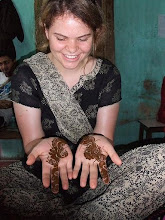
The arrival of our large tourist bus was greeted with a welcoming committee of men with drums standing in front of a huge life-size ornate golden elephant. Upon entry, a demure woman with a tray of red paint greeted us and placed a graceful finger-full on our faces, pressing rice into the wet red mixture with care. The sweat which slicked the surface of my forehead immediately caused this gentle welcoming gesture to become a full on uncontained run of red down the bridge of my nose.
It was clear that our program organizers were very excited about taking us here so I did my best to remain optimistic as we paraded past men and woman in ornate, elaborate costumes meant to replicate dress from many different parts of India. We were given a credit card with 650 rupees that could only be spent at this location and told to find dinner. A few of us wandered until we found a Mumbai chaat stand and availed ourselves of its menu to eat some delicious papri chaat (fried crackers with potatos, lentils, tamarind sauce, yogurt and green chutney).
The strangest part of the experience was that this outrageous tourist attraction, this false recreation of a reality that only exists in travelogues written by colonialists, was filled not with foreign tourists, but with Indians from every corner of the country.
Truly, the experience is best communicated by video:
Now, we are in Jaipur and I’ve moved in with my host family, the Mehrishis. I’ll save their introduction for my next letter, dear reader.
Best,
Cat
Friday, June 17, 2011


Friday, June 10, 2011
Filling in the Blanks
Dear dedicated reader,
“Think of your worst trait and magnify it by ten – that is what you will turn into on your worst day in India.” The woman speaking to us paused to let this sink in. I looked around the hotel conference room, full of prospective Critical Language Scholarship recipients heading to India, and I wondered if everyone else was thinking the same thing as me: what *is* my worst trait?
While conducting this reflection, I realized that, at this point in my life, I have attended no less than four orientations preparing me for life in India – one with Brown, Princeton in Asia, Nanubhai, and now the State Department. Therefore, I have decided that the best way to communicate what the common denominator experience of being oriented for India is like is to provide you with an “India Orientation” Madlib!
“Congratulations ________ (name of group of hopefuls) on your decision to go to India. I’d like to provide you with _______ (amount) of advice about living in India based on my _____ (number) of years of experience. First of all, let’s talk about safety. You should never go out at ______ (time of day) because of _________ (weather/wild dogs/monkeys/rapists) or, if you do, make sure that you have travel in packs or have a male friend with you. Also, please let us know where you are because we are afraid of ______ (threats to your personal safety/litigation).
Now, it is likely that you will fall ill during _____ (some/part/all day everyday) of your visit and therefore you should be prepared with _____ (immodium/doxycycline/advil/lopamine/larium/probiotics/Tylenol pm/Sudafed/cipro/airborne/tums), but, make sure not to self-medicate: go the _______ (qualified medical professional)! One thing that usually makes participants sick is the _____ (food/smells/heat/change in climate/bacteria). Therefore, you should watch what you eat and make sure you never eat _______ (fruit/uncooked vegetables/street food/unfiltered water/anything tasty looking). This will most likely make you feel like ______ (nasty horrible thing). Also, I checked the high in _______ (city of arrival) and it is _____ (three digit number) degrees, so make sure to drink plenty of ____(a liquid).
Getting around in India will also present some challenges. The roads in India are like _______ (something crazy). The most common transportation (unspoken assumption: for foreigners) is the ________ (three wheeled device with an engine taken from a lawnmower). You can take these, but not after ______ (time of day).
You may know that the culture of India is very different from ours, and you may experience some culture shock on your arrival. Men, don’t wear ________ (typically informal American piece of clothing) and women, we suggest that if you don’t want your _______ (Part of the body) stared at or touched that you wear ________ (typically traditional piece of clothing).
Lastly, we’ve purchased travel insurance on your behalf and I’d like to go over it. It provides benefits fo most things, but not ________ (a contact sport), ________ (a pre-existing condition), or _______ (an act of terrorism). So, please keep those restrictions in mind.
We hope you have a great time in India this ______ (summer/year/semester)!
Safe travels!”
Here’s hoping you all now feel fully oriented. We head out to the airport in just a few hours for our flight! The next time that I write to you, dear reader, I will be staying at the Taj Ambassador in Delhi.
Best,
Cat
“Think of your worst trait and magnify it by ten – that is what you will turn into on your worst day in India.” The woman speaking to us paused to let this sink in. I looked around the hotel conference room, full of prospective Critical Language Scholarship recipients heading to India, and I wondered if everyone else was thinking the same thing as me: what *is* my worst trait?
While conducting this reflection, I realized that, at this point in my life, I have attended no less than four orientations preparing me for life in India – one with Brown, Princeton in Asia, Nanubhai, and now the State Department. Therefore, I have decided that the best way to communicate what the common denominator experience of being oriented for India is like is to provide you with an “India Orientation” Madlib!
“Congratulations ________ (name of group of hopefuls) on your decision to go to India. I’d like to provide you with _______ (amount) of advice about living in India based on my _____ (number) of years of experience. First of all, let’s talk about safety. You should never go out at ______ (time of day) because of _________ (weather/wild dogs/monkeys/rapists) or, if you do, make sure that you have travel in packs or have a male friend with you. Also, please let us know where you are because we are afraid of ______ (threats to your personal safety/litigation).
Now, it is likely that you will fall ill during _____ (some/part/all day everyday) of your visit and therefore you should be prepared with _____ (immodium/doxycycline/advil/lopamine/larium/probiotics/Tylenol pm/Sudafed/cipro/airborne/tums), but, make sure not to self-medicate: go the _______ (qualified medical professional)! One thing that usually makes participants sick is the _____ (food/smells/heat/change in climate/bacteria). Therefore, you should watch what you eat and make sure you never eat _______ (fruit/uncooked vegetables/street food/unfiltered water/anything tasty looking). This will most likely make you feel like ______ (nasty horrible thing). Also, I checked the high in _______ (city of arrival) and it is _____ (three digit number) degrees, so make sure to drink plenty of ____(a liquid).
Getting around in India will also present some challenges. The roads in India are like _______ (something crazy). The most common transportation (unspoken assumption: for foreigners) is the ________ (three wheeled device with an engine taken from a lawnmower). You can take these, but not after ______ (time of day).
You may know that the culture of India is very different from ours, and you may experience some culture shock on your arrival. Men, don’t wear ________ (typically informal American piece of clothing) and women, we suggest that if you don’t want your _______ (Part of the body) stared at or touched that you wear ________ (typically traditional piece of clothing).
Lastly, we’ve purchased travel insurance on your behalf and I’d like to go over it. It provides benefits fo most things, but not ________ (a contact sport), ________ (a pre-existing condition), or _______ (an act of terrorism). So, please keep those restrictions in mind.
We hope you have a great time in India this ______ (summer/year/semester)!
Safe travels!”
Here’s hoping you all now feel fully oriented. We head out to the airport in just a few hours for our flight! The next time that I write to you, dear reader, I will be staying at the Taj Ambassador in Delhi.
Best,
Cat
Saturday, June 4, 2011
Back again
Dear dedicated readers (or those of you who still remain),
I’ve long since left Nanubhai and Kadod behind but I am thinking of reviving this blog as I enter into yet another Indian adventure, this time under the purview of the U.S. Department of State’s Critical Language Scholarship program (www.clscholarship.org). I’ll be moving to Jaipur for ten weeks this summer and after a year of doctoral study I’m very much looking forward to seeing my old friend India again, this time, with different eyes.
I remember the very first time that I made the transition across the ocean as a sophomore in college, venturing to this place that I had studied but never seen – the alternating waves of elation and terror were so overwhelming that I considered, on disembarking for my connecting flight in London, simply turning around and going home. When I think back to that first experience, my memory catches on the surface level things – the smells, colors – those things that India is known for. I remember outrageous arguments with autorickshaw drivers and dust and heat and occasionally an elated rain. I remember thinking, “There is no reading about this place. There is only being here.” I still feel that way, even after three years of Indian residency.
The things I read in graduate school about India seem flat – two dimensional. Regardless of the quality of their empirics – their method, their contribution to the literature – it feels far away and somehow lacking. As I’m only a beginning scholar, I struggle sometimes for the proper words to intimate the why behind my feelings of distaste for these studies. Maybe it is that when I think of India, I think of my students, my close friends, the place I lovingly refer to as my village. My mind seems unable to comprehend India in aggregate.
In many ways, my understanding of India is like my Hindi. At first, formally schooled, I studied Hindi and India at a distance, from afar. I immersed myself in its study and believe myself knowledgeable. I was wrong. I couldn’t keep up in a conversation and while I could argue fine, I was miles away from true knowledge of the language. In Kadod, I achieved a sort of unschooled comfort with language and with India – I had to relearn many things that I thought I knew, be always ready for the cognitive dissonance of living in an unfamiliar place. My tongue became accustomed to producing the sounds on command and my mind found a way to reconcile itself to a new palette of experiences by inventing explanations for what I saw that gelled with my American way of understanding the world.
This combination of schooled and unschooled experiences are what I bring to my journey this summer. My relatively fluid Hindi needs grammatical supports – structure – to improve and my mind needs the combination of reflecting on my experiences in reference to theory in order to move forward in my scholarship.
I am hoping to document my attempt to do both of these things. While I cannot promise the array of characters that you came to know and love in my previous blog, I will do my best to communicate my experience with thoughtfulness, honesty, and with some luck, humor.
Best,
Cat
I’ve long since left Nanubhai and Kadod behind but I am thinking of reviving this blog as I enter into yet another Indian adventure, this time under the purview of the U.S. Department of State’s Critical Language Scholarship program (www.clscholarship.org). I’ll be moving to Jaipur for ten weeks this summer and after a year of doctoral study I’m very much looking forward to seeing my old friend India again, this time, with different eyes.
I remember the very first time that I made the transition across the ocean as a sophomore in college, venturing to this place that I had studied but never seen – the alternating waves of elation and terror were so overwhelming that I considered, on disembarking for my connecting flight in London, simply turning around and going home. When I think back to that first experience, my memory catches on the surface level things – the smells, colors – those things that India is known for. I remember outrageous arguments with autorickshaw drivers and dust and heat and occasionally an elated rain. I remember thinking, “There is no reading about this place. There is only being here.” I still feel that way, even after three years of Indian residency.
The things I read in graduate school about India seem flat – two dimensional. Regardless of the quality of their empirics – their method, their contribution to the literature – it feels far away and somehow lacking. As I’m only a beginning scholar, I struggle sometimes for the proper words to intimate the why behind my feelings of distaste for these studies. Maybe it is that when I think of India, I think of my students, my close friends, the place I lovingly refer to as my village. My mind seems unable to comprehend India in aggregate.
In many ways, my understanding of India is like my Hindi. At first, formally schooled, I studied Hindi and India at a distance, from afar. I immersed myself in its study and believe myself knowledgeable. I was wrong. I couldn’t keep up in a conversation and while I could argue fine, I was miles away from true knowledge of the language. In Kadod, I achieved a sort of unschooled comfort with language and with India – I had to relearn many things that I thought I knew, be always ready for the cognitive dissonance of living in an unfamiliar place. My tongue became accustomed to producing the sounds on command and my mind found a way to reconcile itself to a new palette of experiences by inventing explanations for what I saw that gelled with my American way of understanding the world.
This combination of schooled and unschooled experiences are what I bring to my journey this summer. My relatively fluid Hindi needs grammatical supports – structure – to improve and my mind needs the combination of reflecting on my experiences in reference to theory in order to move forward in my scholarship.
I am hoping to document my attempt to do both of these things. While I cannot promise the array of characters that you came to know and love in my previous blog, I will do my best to communicate my experience with thoughtfulness, honesty, and with some luck, humor.
Best,
Cat
Friday, February 19, 2010
Cultural Transition
Dear dedicated reader,
As many of you know, I am no longer residing full-time in India and have largely abandoned this blog. I'm afraid that due to the nature of my new position, it is difficult to a) keep up with it and b) to tell the stories of events from my everyday life with the same voice that I used to employ. I think, in many ways, I have changed over the past year and in some ways the behaviors that used to baffle me no longer cause so much confusion.
I am now residing in Brooklyn, however, and I have to say that I may have to redirect my critical lens to some of the bizarre cultural patterns that I am now being subjected to as a returned ex-pat.
Regardless, this post is to alert you to an article that I had published in Education Times, a sub-section of the Times of India, about my experience as a teacher. The article can be found here:
http://education.indiatimes.com/educationTimes/getArticleDetail.do?sectionid=79&articleid=200911252009112515283162d464467a
Though below is the text, reprinted for you all.
Best,
Cat
Students' Speak: Lost in Translation
On my first day as an English teacher at Kadod High School (in Gujarat), I found myself at the front of a dim classroom in front of over 60 pairs of confused, unblinking eyes. It was June, the fans had slowed to a halt with another electricity cut and I was vainly searching for a piece of chalk and a duster. In America, these staples of the teaching profession are kept in the classroom; I hadnt thought to bring them with me. I was there as a teacher through the Nanubhai Education Foundation, an NGO which works to bridge the gap between rural and urban Indian schools by sending American trained teachers to teach in rural vernacular-medium government schools to improve students English and technology skills.
Lack of amenities
Upon asking, I found that the school had no photocopier and only sponsored photocopies for its teachers with special permission from the principal. The school textbooks were beyond the means of many of my students. In the US, the school I taught at in the poor part of Boston had been deemed under-resourced. Looking around at my current classroom, at the cracked blackboard, the cramped benches and the crumbling walls, I wondered if we in the US could ever understand what under-resourced truly means.
About the students
Despite this, I found that after some shyness my students were practically jumping out of their seats to answer my simple questions that first day. Their eagerness belied their excitement to learn. They hungered for knowledge in a way that I had never seen in my students in America. Furthermore, their respect for their teachers, their respect of the knowledge that their teachers offered them, was unlike anything I had ever seen while teaching in Boston or even in my own days as a student.
However, I was soon to learn the constraints within which this eagerness is regularly channeled. “Teacher, should we copy our essay in a blue pen or a black pen,” asked one diligent student, as I worked at writing away on the blackboard. I cringed inwardly and instructed the student, as I myself had been instructed by the other teachers, to copy the essay in a blue pen. Turning back to the board, I continued to copy an essay on the dull topic ‘Computers and the Future’ from a cheaply printed exam guide.
Copying, I had been told by other teachers, is a necessary evil. The annual exam is graded harshly and mistakes are not tolerated in student’s essays. The level of English expected from class IX students does not match their current ability level, after years of learning English from government teachers, who barely speak the language themselves. Many of the students I taught could barely read English, couldn’t speak at all and yet, somehow still managed to pass the annual exam because of teaching practices such as these. Is this a triumph of ingenuity of the schools to make up for what they lack or a symptom of a much bigger disservice to its students by the Indian government or is it both?
Comparing classrooms
As for myself, I could only capitulate to the system. The methods that I learned as a teacher, in the US, for engaging the students in an interactive environment, were meant for classes of 30 in classroom spaces that allowed for some freedom of movement. These methods did not translate to my classes of 60 with barely enough room for me to pass between benches to check my students work. Furthermore, the school administration did not appreciate my attempts at classroom interactivity. I was often told to control my classroom better and that Indian students learned better sitting at desks and copying things off the board than by playing games.
For me, this begged the question - did the students learn better or memorise better? Does memorisation denote true understanding?
As an American, I can sing the words to popular Hindi songs without understanding them. Can English be learned as merely another subject like math or science where one memorises the relevant facts and regurgitates them for the annual exam or does the language require a certain special treatment that the government syllabus has yet to accord it?
Concluding questions
On a policy level, I hear that things are changing. At a conference I attended last week, run by the English Language Teachers Association of India, a Gujarati policymaker informed the participants that reforms in the way English is taught are being pushed forward. For example, Gujarat now requires an oral test of the class VIII and IX students. These fabled reforms have indeed filtered down to the practice level. However, I’ve watched these oral exams actually administered. The teacher asks the student to recite a poem or an essay that they have memorised and then grades them on how well they remember it. Is this what policymakers had in mind?
In the end, I think the question is - what does learning look like? As an American educator working in the Indian context, it is a question that I found myself asking every day. I find that I do not have an answer, instead I have one last question - will these methods prepare these motivated students for life outside the school?
(The writer is the Executive Director of Nanubhai Education Foundation and a former full-time teacher at Kadod High School. Her interest in Indian development began at Brown University, where she double majored in South Asian Studies and History and spent her junior year studying at St Stephen’s College in Delhi while interning for the NGO TARSHI)
As many of you know, I am no longer residing full-time in India and have largely abandoned this blog. I'm afraid that due to the nature of my new position, it is difficult to a) keep up with it and b) to tell the stories of events from my everyday life with the same voice that I used to employ. I think, in many ways, I have changed over the past year and in some ways the behaviors that used to baffle me no longer cause so much confusion.
I am now residing in Brooklyn, however, and I have to say that I may have to redirect my critical lens to some of the bizarre cultural patterns that I am now being subjected to as a returned ex-pat.
Regardless, this post is to alert you to an article that I had published in Education Times, a sub-section of the Times of India, about my experience as a teacher. The article can be found here:
http://education.indiatimes.com/educationTimes/getArticleDetail.do?sectionid=79&articleid=200911252009112515283162d464467a
Though below is the text, reprinted for you all.
Best,
Cat
Students' Speak: Lost in Translation
On my first day as an English teacher at Kadod High School (in Gujarat), I found myself at the front of a dim classroom in front of over 60 pairs of confused, unblinking eyes. It was June, the fans had slowed to a halt with another electricity cut and I was vainly searching for a piece of chalk and a duster. In America, these staples of the teaching profession are kept in the classroom; I hadnt thought to bring them with me. I was there as a teacher through the Nanubhai Education Foundation, an NGO which works to bridge the gap between rural and urban Indian schools by sending American trained teachers to teach in rural vernacular-medium government schools to improve students English and technology skills.
Lack of amenities
Upon asking, I found that the school had no photocopier and only sponsored photocopies for its teachers with special permission from the principal. The school textbooks were beyond the means of many of my students. In the US, the school I taught at in the poor part of Boston had been deemed under-resourced. Looking around at my current classroom, at the cracked blackboard, the cramped benches and the crumbling walls, I wondered if we in the US could ever understand what under-resourced truly means.
About the students
Despite this, I found that after some shyness my students were practically jumping out of their seats to answer my simple questions that first day. Their eagerness belied their excitement to learn. They hungered for knowledge in a way that I had never seen in my students in America. Furthermore, their respect for their teachers, their respect of the knowledge that their teachers offered them, was unlike anything I had ever seen while teaching in Boston or even in my own days as a student.
However, I was soon to learn the constraints within which this eagerness is regularly channeled. “Teacher, should we copy our essay in a blue pen or a black pen,” asked one diligent student, as I worked at writing away on the blackboard. I cringed inwardly and instructed the student, as I myself had been instructed by the other teachers, to copy the essay in a blue pen. Turning back to the board, I continued to copy an essay on the dull topic ‘Computers and the Future’ from a cheaply printed exam guide.
Copying, I had been told by other teachers, is a necessary evil. The annual exam is graded harshly and mistakes are not tolerated in student’s essays. The level of English expected from class IX students does not match their current ability level, after years of learning English from government teachers, who barely speak the language themselves. Many of the students I taught could barely read English, couldn’t speak at all and yet, somehow still managed to pass the annual exam because of teaching practices such as these. Is this a triumph of ingenuity of the schools to make up for what they lack or a symptom of a much bigger disservice to its students by the Indian government or is it both?
Comparing classrooms
As for myself, I could only capitulate to the system. The methods that I learned as a teacher, in the US, for engaging the students in an interactive environment, were meant for classes of 30 in classroom spaces that allowed for some freedom of movement. These methods did not translate to my classes of 60 with barely enough room for me to pass between benches to check my students work. Furthermore, the school administration did not appreciate my attempts at classroom interactivity. I was often told to control my classroom better and that Indian students learned better sitting at desks and copying things off the board than by playing games.
For me, this begged the question - did the students learn better or memorise better? Does memorisation denote true understanding?
As an American, I can sing the words to popular Hindi songs without understanding them. Can English be learned as merely another subject like math or science where one memorises the relevant facts and regurgitates them for the annual exam or does the language require a certain special treatment that the government syllabus has yet to accord it?
Concluding questions
On a policy level, I hear that things are changing. At a conference I attended last week, run by the English Language Teachers Association of India, a Gujarati policymaker informed the participants that reforms in the way English is taught are being pushed forward. For example, Gujarat now requires an oral test of the class VIII and IX students. These fabled reforms have indeed filtered down to the practice level. However, I’ve watched these oral exams actually administered. The teacher asks the student to recite a poem or an essay that they have memorised and then grades them on how well they remember it. Is this what policymakers had in mind?
In the end, I think the question is - what does learning look like? As an American educator working in the Indian context, it is a question that I found myself asking every day. I find that I do not have an answer, instead I have one last question - will these methods prepare these motivated students for life outside the school?
(The writer is the Executive Director of Nanubhai Education Foundation and a former full-time teacher at Kadod High School. Her interest in Indian development began at Brown University, where she double majored in South Asian Studies and History and spent her junior year studying at St Stephen’s College in Delhi while interning for the NGO TARSHI)
Wednesday, November 18, 2009
Training Begins
Dear dedicated reader,
It is only proper that I begin with the context: a number of the more athletically motivated fellows staff have decided that they are going to run a half marathon in February to raise money for Nanubhai and as a way to keep fit and motivate themselves. While seated around the dinner table in the Bajipura apartment, infected with their raucous enthusiasm, I decided that if my staff could do it, well by golly so could I.
Since that time roughly two weeks ago, the general upheaval which characterizes my life in this country has come in to play and by fate’s roll of the dice I no longer live in our Bajipura apartment and have moved into the downstairs bedroom of our two fellows who live in Surat, the nearest city where we have one site at P.R. Khatiwala High School. Now that I’m located in a city, I have access to all sorts of amenities within a 5 minute autorickshaw ride of the house such as a real grocery store, a mall, a coffee shop, and most of all, a gym.
All of this contributed to the optimism which prompted me to decide to go running in the area surrounding our house.
I start out blissfully content with the morning sun shining down on our porch, the act of stretching bringing on that sense of enlightened anticipation that it always fills me with. With a flick of my finger, my ipod brings the upbeat strains of Natasha Bedinfield into my ears, telling me that not only is this morning beautiful, but ‘no one else could feel it for [me]’ and that I should ‘live my life with arms wide open.’ Sentimental state that I am in, it only heightens my euphoria.
After a brief stretch of the limbs, I set out gently from our porch, jogging my way through gated society and observing the mid-morning activities of our neighbors: hair-brushing, hanging clothes on the line, talking on the phone. I feel almost transported back to the Porter Street hill in Somerville down which I had to go for all my morning and weekend runs, that sense of energy filling my limbs as I strode downhill, until I finally hit the turn onto the main Highland Ave and set off on the real test of endurance. It is like that this morning, hitting the road that leads past Khatiwala High School (which we live behind) until I arrive at the main highway.
The first reservations set in as I observe a group of men sitting shirtless by the side of the road, the pick axes by their side indicating previous intense physical labor, the glistening of their skin the sun corroborating this assumption. As I put one foot in front of the other and naturally speed up as if to prove something, I can’t help but register the absurdity of my running to compensate for me sedentary lifestyle. No matter, I think, push on.
The real uncertainty hits as I realize that I am going about the same speed as a stringy man in a torn shirt ahead of me pushing a loaded down flatbed pushcart to which he is applying all his bodily strength to move its reluctant wagon wheels forward. To avoid comparison, I speed up, which of course leads to my lungs starting to burn and the slowing of my pace as I turn around and head back in the other direction.
Surat, you should know, dear reader, was 7 years ago proclaimed the most polluted city in India. While that title since has been bestowed upon some other hardworking and deserving city, the smog stained buildings and the thick haze hanging over the highway despite the sunny morning make it easy to see how that might have been the case. Like Providence, everyone claims that Surat has come so far, but I can attest that they are a long way from ‘Water-Fire’ like rebirth.
At this point in the run, despite Katy Perry enticing me onwards, I slow to a walk, my lungs really burning and the remnants of last week’s cold blocking my nose. Whether this halt is a result of my general poor level of fitness or Surat’s smog or the rising temperature of India at mid-morning or that cigarette I smoked when I was Thailand, it is hard to know; but at this point I am definitely feeling my optimism begin to curl into a ball and hide behind the cloudiness building up in my head.
According to my rough estimate, I have been running for 10 minutes.
I begin to do a sort of compromised run-walk that pacifies my sense of determination as well as my failing body until through the motivating beats of Jordin Sparks I hear jeering coming from the side of the road. I turn my head in time to see a bus full of private school boys, arms flailing out of the window to catch my attention, urging me onwards. I begin to miss the sweet, adorable faces of my students at Kadod and mentally curse the obnoxiousness of the over-privileged adolescent. Until, of course, I remember that I was one.
The nail in the coffin is a number of Rajasthani women, heads covered with the tails of their saris, giving me a look of horror as I shuffle onward. I smile in a lopsided way and slow to a real walk, turning back down the road to the house in embarrassed defeat and mentally filing this under “Notable experiences” in sub-category “Reasons I need to join a proper gym.”
Best,
Cat
It is only proper that I begin with the context: a number of the more athletically motivated fellows staff have decided that they are going to run a half marathon in February to raise money for Nanubhai and as a way to keep fit and motivate themselves. While seated around the dinner table in the Bajipura apartment, infected with their raucous enthusiasm, I decided that if my staff could do it, well by golly so could I.
Since that time roughly two weeks ago, the general upheaval which characterizes my life in this country has come in to play and by fate’s roll of the dice I no longer live in our Bajipura apartment and have moved into the downstairs bedroom of our two fellows who live in Surat, the nearest city where we have one site at P.R. Khatiwala High School. Now that I’m located in a city, I have access to all sorts of amenities within a 5 minute autorickshaw ride of the house such as a real grocery store, a mall, a coffee shop, and most of all, a gym.
All of this contributed to the optimism which prompted me to decide to go running in the area surrounding our house.
I start out blissfully content with the morning sun shining down on our porch, the act of stretching bringing on that sense of enlightened anticipation that it always fills me with. With a flick of my finger, my ipod brings the upbeat strains of Natasha Bedinfield into my ears, telling me that not only is this morning beautiful, but ‘no one else could feel it for [me]’ and that I should ‘live my life with arms wide open.’ Sentimental state that I am in, it only heightens my euphoria.
After a brief stretch of the limbs, I set out gently from our porch, jogging my way through gated society and observing the mid-morning activities of our neighbors: hair-brushing, hanging clothes on the line, talking on the phone. I feel almost transported back to the Porter Street hill in Somerville down which I had to go for all my morning and weekend runs, that sense of energy filling my limbs as I strode downhill, until I finally hit the turn onto the main Highland Ave and set off on the real test of endurance. It is like that this morning, hitting the road that leads past Khatiwala High School (which we live behind) until I arrive at the main highway.
The first reservations set in as I observe a group of men sitting shirtless by the side of the road, the pick axes by their side indicating previous intense physical labor, the glistening of their skin the sun corroborating this assumption. As I put one foot in front of the other and naturally speed up as if to prove something, I can’t help but register the absurdity of my running to compensate for me sedentary lifestyle. No matter, I think, push on.
The real uncertainty hits as I realize that I am going about the same speed as a stringy man in a torn shirt ahead of me pushing a loaded down flatbed pushcart to which he is applying all his bodily strength to move its reluctant wagon wheels forward. To avoid comparison, I speed up, which of course leads to my lungs starting to burn and the slowing of my pace as I turn around and head back in the other direction.
Surat, you should know, dear reader, was 7 years ago proclaimed the most polluted city in India. While that title since has been bestowed upon some other hardworking and deserving city, the smog stained buildings and the thick haze hanging over the highway despite the sunny morning make it easy to see how that might have been the case. Like Providence, everyone claims that Surat has come so far, but I can attest that they are a long way from ‘Water-Fire’ like rebirth.
At this point in the run, despite Katy Perry enticing me onwards, I slow to a walk, my lungs really burning and the remnants of last week’s cold blocking my nose. Whether this halt is a result of my general poor level of fitness or Surat’s smog or the rising temperature of India at mid-morning or that cigarette I smoked when I was Thailand, it is hard to know; but at this point I am definitely feeling my optimism begin to curl into a ball and hide behind the cloudiness building up in my head.
According to my rough estimate, I have been running for 10 minutes.
I begin to do a sort of compromised run-walk that pacifies my sense of determination as well as my failing body until through the motivating beats of Jordin Sparks I hear jeering coming from the side of the road. I turn my head in time to see a bus full of private school boys, arms flailing out of the window to catch my attention, urging me onwards. I begin to miss the sweet, adorable faces of my students at Kadod and mentally curse the obnoxiousness of the over-privileged adolescent. Until, of course, I remember that I was one.
The nail in the coffin is a number of Rajasthani women, heads covered with the tails of their saris, giving me a look of horror as I shuffle onward. I smile in a lopsided way and slow to a real walk, turning back down the road to the house in embarrassed defeat and mentally filing this under “Notable experiences” in sub-category “Reasons I need to join a proper gym.”
Best,
Cat
Friday, July 31, 2009
Alternative Transport System
Dear dedicated reader,
After many aborted attempts to get my driver’s license so I could buy a motor scooter and zip happily and efficiently between the schools I must visit to observe our Fellows, I must bow to the monolith of Indian bureaucracy and admit defeat. Why I cannot get my license is an overdue story for another time: needless to say, I have discovered another way to jet between schools and it is not the bumbling local bus system.
 I stumbled upon the “chakra” system of transportation by accident: I never had any reason to discover it when I lived in Kadod because I never had any reason to travel anywhere that wasn’t regularly serviced by buses. A chakra is an over-sized autorickshaw: basically like a normal auto-rickshaw but with a backseat. I’ve sometimes heard them referred to as tempos in other places around the country. Locally, they are the source of controversy and with reason: I thought it was only my American sensibilities that found the idea of cramming 14 people into space meant comfortably for 7 and watching the driver drive with four men sharing the front seat with him ludicrous, but it turns out the locals feel this way as well. Darshanbhai, Kadod’s local phone booth owner, warned me off the chakras, citing the state of Indian roads: “Driving is crazy! In buses, government will give you money for accident and hurt. Government will give you nothing if you are hurt in chakra!”
 Sadly, I must take my chances. The entrepreneurial spirit of the chakra drivers appeals to me and furthermore, the bus only comes about once every one and a half to two hours. To take a chakra is the same price as the bus and they leave much more often. What is the catch, I hear you ask? Well, they drive like maniacs, overcrowd the vehicle to the point of people hanging off of it and they won’t leave until they’ve reached hanging off capacity, which means you could be waiting for the chakra to go almost as long as the bus, depending on the time of day. However, its added modicum of efficiency is enough to convert me to traveling using the system daily.
I found myself waiting today, as I often am, at the Madhi bus station. In order to get from my current residence in Bajipura to visit my old home town of Kadod and the new teachers stationed there, I must change chakras at the Madhi bus stand, which is located in between Kadod and Bajipura since there are no direct chakras that go from Bajipura to Kadod. This change can take anywhere from 5 to 50 minutes, depending on the time of day and the whim/greed of the chakra drivers.
The drivers themselves, despite their insistence on ignoring my pleas to please leave when they have sufficient passengers, have taken an interest in me. Because I’m often at the station by myself in the middle of the day waiting in the back of one or another of their vehicles, in the beginning, they took to standing around at a safe distance and gawking at me. When the word spread that I could speak Hindi (the chakra network updates almost as quickly as Twitter, or so it would seem), they dared to take a step closer and ask me a few questions, mostly predictable: where are you from? Why are you here? Do you know those other girls teaching at Madhi? Do you like India? Etc.
At first, I answered cautiously, unsure of their motivation. I was still new at the system, I hadn’t yet learned which drivers go between which villages and who lives where and who will take you home if you get stuck near nightfall at the Madhi bus station or who will let you pay later if you don’t have a five rupee coin. Each passing day, I’ve learned more: who listens to old hindi music and which drivers like the poppy new versions, who has children, who can read. Each day, they’ve asked me more about myself: why did I come here? Why do we teach in the schools? Do I miss my family? Who is in my family? The camaraderie between myself and these men, young and old, was totally unexpected.
It still won’t get them to leave with only 13 passengers though. Rupee beats relationship, or so it would seem.
Best,
Cat
After many aborted attempts to get my driver’s license so I could buy a motor scooter and zip happily and efficiently between the schools I must visit to observe our Fellows, I must bow to the monolith of Indian bureaucracy and admit defeat. Why I cannot get my license is an overdue story for another time: needless to say, I have discovered another way to jet between schools and it is not the bumbling local bus system.
 I stumbled upon the “chakra” system of transportation by accident: I never had any reason to discover it when I lived in Kadod because I never had any reason to travel anywhere that wasn’t regularly serviced by buses. A chakra is an over-sized autorickshaw: basically like a normal auto-rickshaw but with a backseat. I’ve sometimes heard them referred to as tempos in other places around the country. Locally, they are the source of controversy and with reason: I thought it was only my American sensibilities that found the idea of cramming 14 people into space meant comfortably for 7 and watching the driver drive with four men sharing the front seat with him ludicrous, but it turns out the locals feel this way as well. Darshanbhai, Kadod’s local phone booth owner, warned me off the chakras, citing the state of Indian roads: “Driving is crazy! In buses, government will give you money for accident and hurt. Government will give you nothing if you are hurt in chakra!”
 Sadly, I must take my chances. The entrepreneurial spirit of the chakra drivers appeals to me and furthermore, the bus only comes about once every one and a half to two hours. To take a chakra is the same price as the bus and they leave much more often. What is the catch, I hear you ask? Well, they drive like maniacs, overcrowd the vehicle to the point of people hanging off of it and they won’t leave until they’ve reached hanging off capacity, which means you could be waiting for the chakra to go almost as long as the bus, depending on the time of day. However, its added modicum of efficiency is enough to convert me to traveling using the system daily.
 I found myself waiting today, as I often am, at the Madhi bus station. In order to get from my current residence in Bajipura to visit my old home town of Kadod and the new teachers stationed there, I must change chakras at the Madhi bus stand, which is located in between Kadod and Bajipura since there are no direct chakras that go from Bajipura to Kadod. This change can take anywhere from 5 to 50 minutes, depending on the time of day and the whim/greed of the chakra drivers.
The drivers themselves, despite their insistence on ignoring my pleas to please leave when they have sufficient passengers, have taken an interest in me. Because I’m often at the station by myself in the middle of the day waiting in the back of one or another of their vehicles, in the beginning, they took to standing around at a safe distance and gawking at me. When the word spread that I could speak Hindi (the chakra network updates almost as quickly as Twitter, or so it would seem), they dared to take a step closer and ask me a few questions, mostly predictable: where are you from? Why are you here? Do you know those other girls teaching at Madhi? Do you like India? Etc.
At first, I answered cautiously, unsure of their motivation. I was still new at the system, I hadn’t yet learned which drivers go between which villages and who lives where and who will take you home if you get stuck near nightfall at the Madhi bus station or who will let you pay later if you don’t have a five rupee coin. Each passing day, I’ve learned more: who listens to old hindi music and which drivers like the poppy new versions, who has children, who can read. Each day, they’ve asked me more about myself: why did I come here? Why do we teach in the schools? Do I miss my family? Who is in my family? The camaraderie between myself and these men, young and old, was totally unexpected.
It still won’t get them to leave with only 13 passengers though. Rupee beats relationship, or so it would seem.
Best,
Cat
Wednesday, July 15, 2009
Poor Substitute
Dear dedicated reader,
I am sorely behind in my accounts to you. I don't make my apology lightly - I think about you almost daily and hope that my anecdotes of daily life here can resume once things become a little more settled. In the meantime, I present the following to you as a poor substitute for my usual detailed updates.
I had an article published in the Indian paper DNA recently that provides a more rounded reflection on my experience than I usually provide. If you are interested, it can be found here:
http://www.dnaindia.com/india/interview_indian-student-works-hard-but-isn-t-prepared-for-jobs_1273822
Best,
Cat
I am sorely behind in my accounts to you. I don't make my apology lightly - I think about you almost daily and hope that my anecdotes of daily life here can resume once things become a little more settled. In the meantime, I present the following to you as a poor substitute for my usual detailed updates.
I had an article published in the Indian paper DNA recently that provides a more rounded reflection on my experience than I usually provide. If you are interested, it can be found here:
http://www.dnaindia.com/india/interview_indian-student-works-hard-but-isn-t-prepared-for-jobs_1273822
Best,
Cat
Subscribe to:
Posts (Atom)


 Posts
Posts